

Neural rendering vs. traditional rendering is where yesterday’s painstaking frames collide with tomorrow’s instant imagery. In this AI Movie Street sub-category, you’ll explore how classic ray tracing and raster pipelines compare with neural radiance fields, diffusion-based renderers, and learned scene representations reshaping the look—and speed—of modern film. We break down how traditional rendering wins on predictability and control, while neural methods promise real-time lighting, ultra-fast iteration, and uncanny realism from sparse data. Through side-by-side examples, workflow guides, and tool roundups, you’ll see exactly where each approach shines: from pre-vis and virtual production to final VFX and animated features. Whether you’re a seasoned TD, an indie filmmaker, or a curious creator trying to future-proof your pipeline, “Neural rendering vs. traditional rendering” will help you decode the tech, avoid the hype, and mix the best of both worlds into one powerful cinematic toolkit.
A: Not soon. Most real productions use hybrids, leveraging the strengths of both.
A: For some content, yes. For hero shots, many teams still rely on traditional engines.
A: It can. Faster iteration might influence coverage, pre-vis, and VFX planning.
A: Artists familiar with CG adapt quickly; the main shift is thinking in terms of training and data.
A: Style guides, LUTs, and shared models help keep sequences coherent.
A: In many cases, yes—especially for previews, variants, and environment-heavy shots.
A: Store source assets and model checkpoints so future teams can rebuild or retrain as needed.
A: Strong GPUs help, but many tools run on existing editorial/VFX machines.
A: Pilot neural workflows on select shots while keeping a traditional fallback ready.
A: Pipeline TDs and CG supervisors usually lead, in close collaboration with directors and VFX leads.

How AI Is Automating Post-Production: Neural Rendering vs Traditional Workflows
A clear comparison of neural rendering and traditional post-production workflows, explaining how AI automation is changing VFX, finishing, and review.
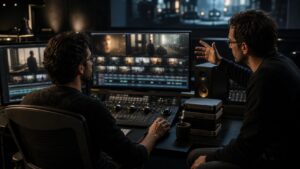
Neural Rendering Automation Explained: The Future of Editing and Post
A clear explainer on neural rendering automation and how it may shape editing, visual effects, finishing, restoration, and future post-production workflows.

AI vs Human Editors: How Much Post-Production Can Be Automated?
A balanced guide to AI vs human editors, explaining which post-production tasks can be automated and which still depend on human judgment.