AI Can Help Build Worlds Faster, But Rules Make Them Believable
AI-assisted worldbuilding helps filmmakers and series creators explore environments, cultures, histories, objects, costumes, social rules, and visual systems before production decisions are locked. It can generate references quickly, compare design directions, and help teams imagine a world at scale. But a believable world is not a pile of images. It has rules, consequences, continuity, and a relationship to character. AI can widen the worldbuilding process, but the showrunner, director, writer, and production designer still decide what the world means and how it behaves.
Start With World Rules
A world needs rules before it needs images. Rules define climate, technology, politics, class, belief, materials, geography, and what people consider normal. AI can help brainstorm these rules, but humans must choose the ones that matter.
Without rules, generated worlds often look impressive but inconsistent. One image may suggest ancient stone, another chrome futurism, another desert nomads. The team needs a spine.
Worldbuilding for Story
Worldbuilding should pressure the story. A city, kingdom, school, ship, neighborhood, or planet should affect what characters want and what choices are available to them.
AI can generate decorative detail endlessly. Filmmakers should keep the details that create conflict, status, danger, mystery, or emotional meaning.
Visual Systems
A visual system includes materials, color, architecture, costume, props, vehicles, tools, and environmental texture. AI can quickly create options for each element.
The production designer should turn those options into a controlled language. What shapes repeat. What materials are forbidden. What colors signal power, poverty, ritual, or danger.
Culture and Daily Life
Worlds feel real when they include daily life. How do people eat, travel, work, worship, repair things, trade, celebrate, or grieve. AI can suggest possibilities, but research and human imagination make them specific.
Daily-life details should not become exposition. They should appear through behavior, objects, background action, and character choices.
Continuity Across a Series
Series worldbuilding requires continuity across episodes and seasons. A rule introduced early may affect later stories. A costume language, political structure, or geography choice can become a long-term commitment.
AI-generated references should be tracked carefully so the world does not drift. Approved rules need to be separated from early experiments.
Using AI for Environment Exploration
AI can help explore locations quickly: markets, temples, homes, control rooms, forests, stations, streets, or battlefields. It can show how the world changes across class, weather, time, or region.
The team should review whether each environment supports action. A beautiful room is less useful if characters cannot move, hide, confront, or reveal information inside it.
Props and Objects
Objects make worlds tangible. Tools, weapons, books, toys, money, clothing fasteners, food containers, and worn personal items can reveal the rules of a world.
AI can suggest object families, but departments need to decide what can be built, rented, modified, or digitally extended.
Language Without Exposition
Worldbuilding often tempts writers to explain everything. AI can generate histories and terms, but the film or series should reveal only what the audience needs.
A strong world lets viewers infer. A ritual, uniform, gesture, or street design can communicate more elegantly than a speech.
World Bibles
AI can help draft a world bible, but the bible should be curated. It should include approved rules, visual references, timelines, geography, terminology, and open questions.
A bloated world bible can slow production. The best version helps writers and departments make consistent choices quickly.
Production Design Collaboration
Production designers are essential because AI output needs taste, logic, and buildability. A generated world may include impossible materials, unclear scale, or designs that do not support camera movement.
Designers translate exploration into sets, props, textures, color systems, and practical decisions.
Avoiding Lore Overload
Lore overload happens when the world becomes more important than the story. AI can make this worse by generating endless histories, factions, terms, and visual details.
Creators should ask which details affect character decisions. If a detail never changes action or emotion, it may belong in the archive rather than the script.
Testing the World With Scenes
A world should be tested through scenes. Put characters inside the rules and see what happens. Do the rules create pressure. Do locations support blocking. Do objects reveal behavior.
AI can help generate scenario tests, but the writers and directors decide whether those tests create drama.
Worldbuilding Across Departments
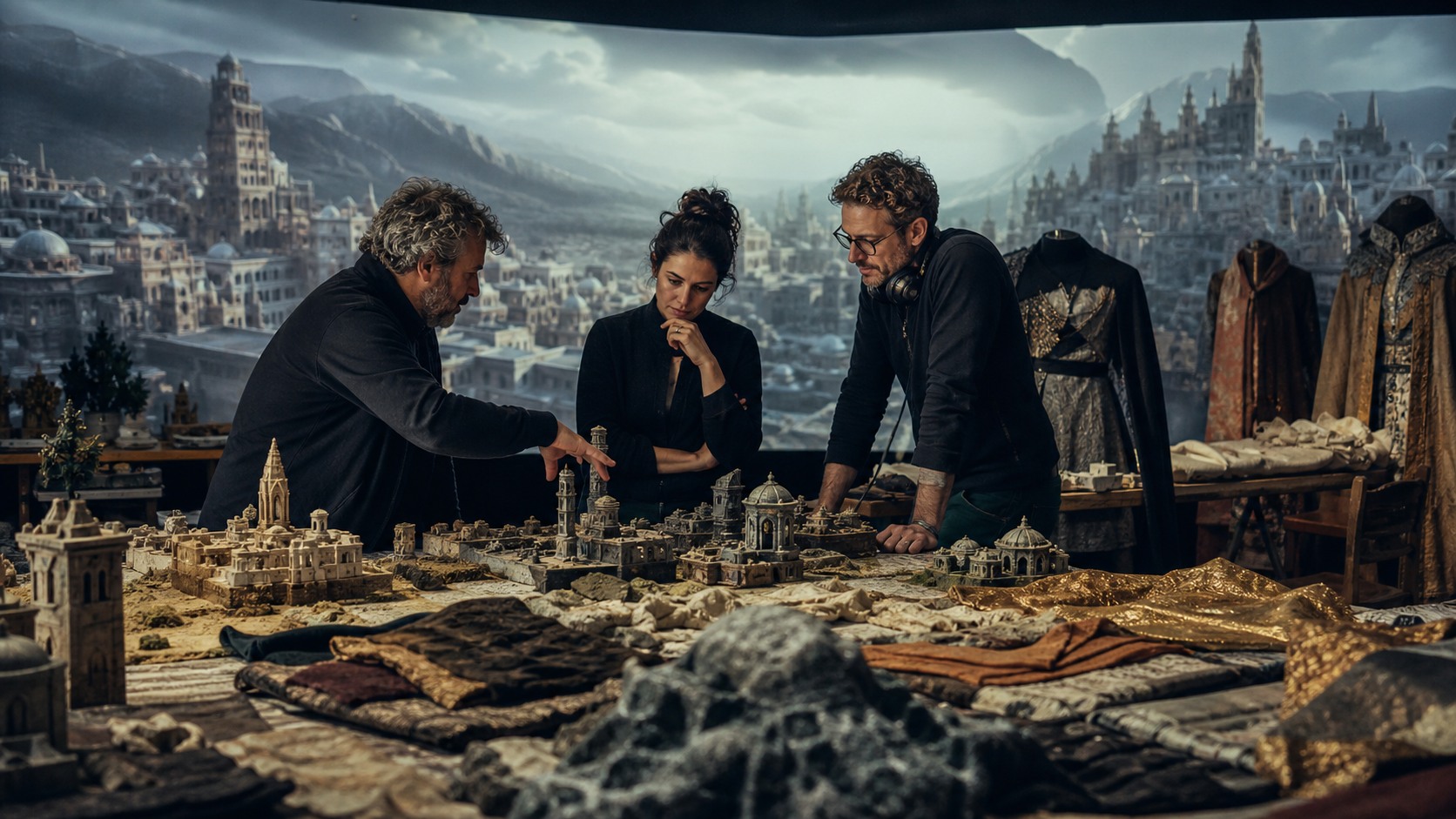
Worldbuilding becomes real when departments share the same assumptions. The writer may describe a society as resource-starved, but that idea also needs to appear in costume repair, prop reuse, architecture, transportation, lighting, and background behavior.
AI references can help departments see possibilities early, but they need a common approval path. Otherwise, costume may design scarcity one way while production design suggests abundance. The result can feel expensive yet incoherent.
A curated world system helps every department answer practical questions. What materials are common. What objects are precious. What shapes suggest authority. What details reveal private life.
Designing Limits
Limits make worlds memorable. A fantasy world where magic can solve every problem becomes less dramatic. A future city where technology does everything may remove human risk. A generated world can become too capable unless creators define what it cannot do.
AI can help list possible limits, but the team should choose limits that create story pressure. Scarce power, restricted travel, social surveillance, fragile materials, or forbidden knowledge can all make choices harder. Those limits turn worldbuilding into drama.
The strongest rules are felt through consequence. If a rule never costs anyone anything, the audience may not believe it matters.
Regional and Class Differences
Large worlds need variation, but variation should follow logic. Wealthy districts, border regions, sacred spaces, industrial zones, and private homes may all express the same world rules differently. AI can generate those differences quickly if the prompt includes social and geographic constraints.
Creators should avoid making every location feel like a separate concept pitch. The audience needs to sense that these places belong to one world. Repeated materials, shared symbols, consistent weathering, and related shapes can hold variation together.
This is particularly useful for series, where the world must expand without feeling redesigned every episode.
Pitching With World References
AI-assisted worldbuilding can help pitch a movie or series because it gives investors, collaborators, and department heads a clearer sense of scale. A few curated references can communicate tone faster than pages of lore.
The pitch deck should show approved direction, not every experiment. Too many disconnected images can make the project seem less controlled. A tighter set of references tells people what kind of world the team intends to build and what emotional experience it should create.
Good worldbuilding images invite production conversation. They help people ask about budget, sets, effects, locations, and story rather than simply admiring the surface.
Worldbuilding as Constraint for Writers
World rules can help writers make better scenes because they limit what characters can do. If travel is dangerous, a reunion costs more. If status is visible in clothing, a disguise has consequences. If a society tracks speech, even a private conversation becomes tense. AI can help explore those constraints, but the writing team chooses the rules that create the richest drama.
This is where worldbuilding stops being decoration. A rule should change choices. A location should affect tactics. An object should reveal history, power, or need. When the world only surrounds the story, it feels like background. When the world changes what characters can risk, it becomes part of the story engine.
Writers should keep a short list of active world constraints near the script. That list can prevent easy escapes, remind scenes to use the setting, and help episodes feel connected. It also gives AI prompts stronger boundaries when creators ask for new scene or environment ideas.
The best fictional worlds feel larger than the story, but they still serve the scene in front of us.
Audience Discovery
A strong movie or series does not explain the whole world at once. It lets the audience discover rules through action, surprise, and consequence. AI can generate long histories, but screen storytelling usually needs a controlled path of discovery.
Creators can use AI to plan what the audience learns early, what remains mysterious, and what later reveals reframe earlier details. That sequence of discovery is part of pacing. Too much explanation early can flatten wonder. Too little clarity can make the world feel arbitrary.
The audience should feel that the world has depth beyond the frame, but the film should not require a textbook to follow the scene. A gesture, street design, costume repair, or forbidden object can carry more meaning than a lecture.
This balance is especially important for series. Each episode can expand the world while preserving questions that keep viewers curious.
Archiving Rejected Ideas
AI exploration creates many rejected ideas. Those ideas should be archived, not mixed with approved world rules. A rejected temple design, faction name, vehicle shape, or climate rule can confuse future collaborators if it remains in the same folder as final references.
A clean archive protects continuity. It lets the team revisit experiments without accidentally treating them as canon. This is useful when a series returns to an old location or when a department needs to understand why a design path was abandoned.
The archive can also preserve creative range. Sometimes an idea rejected for season one becomes useful later after the story expands. The key is labeling. Approved, experimental, rejected, and pending materials should not look the same to a busy team.
AI makes worldbuilding faster, so organization has to become more deliberate.
A simple status system can help: approved for canon, visual exploration only, rejected for conflict with rules, pending production review, or saved for later seasons. That structure keeps creative abundance from becoming noise. It also helps new collaborators join the project without accidentally reviving old choices.
The archive should include reasons, not only images. Knowing why an idea was rejected can be as valuable as the idea itself, because it teaches the team what the world is not.
This is especially useful when the production grows. New writers, artists, or vendors can understand the logic behind the world instead of repeating old experiments. The archive becomes a map of creative decisions, not a dumping ground.
A disciplined archive also protects the approved vision from drift. When every generated option feels available, the world can lose its identity. When rejected ideas are clearly marked, the final world stays sharper.
The Practical Takeaway
AI-assisted worldbuilding is useful because it expands exploration and helps teams visualize rules, environments, culture, objects, and style quickly.
Its risk is incoherence. A world made of disconnected generated ideas may look large but feel shallow.
The practical goal is controlled abundance: explore widely, approve narrowly, and keep the rules visible to every collaborator who touches the story or design. That discipline lets a fictional world expand without losing its identity.
When the system is clear, every new location, object, costume, and ritual feels connected to the same imagined reality for audiences and collaborators alike.
Use AI to explore, then build a clear world system that supports story, character, production, and continuity.