AI Is Becoming a Direction Support Layer, Not a Replacement Director
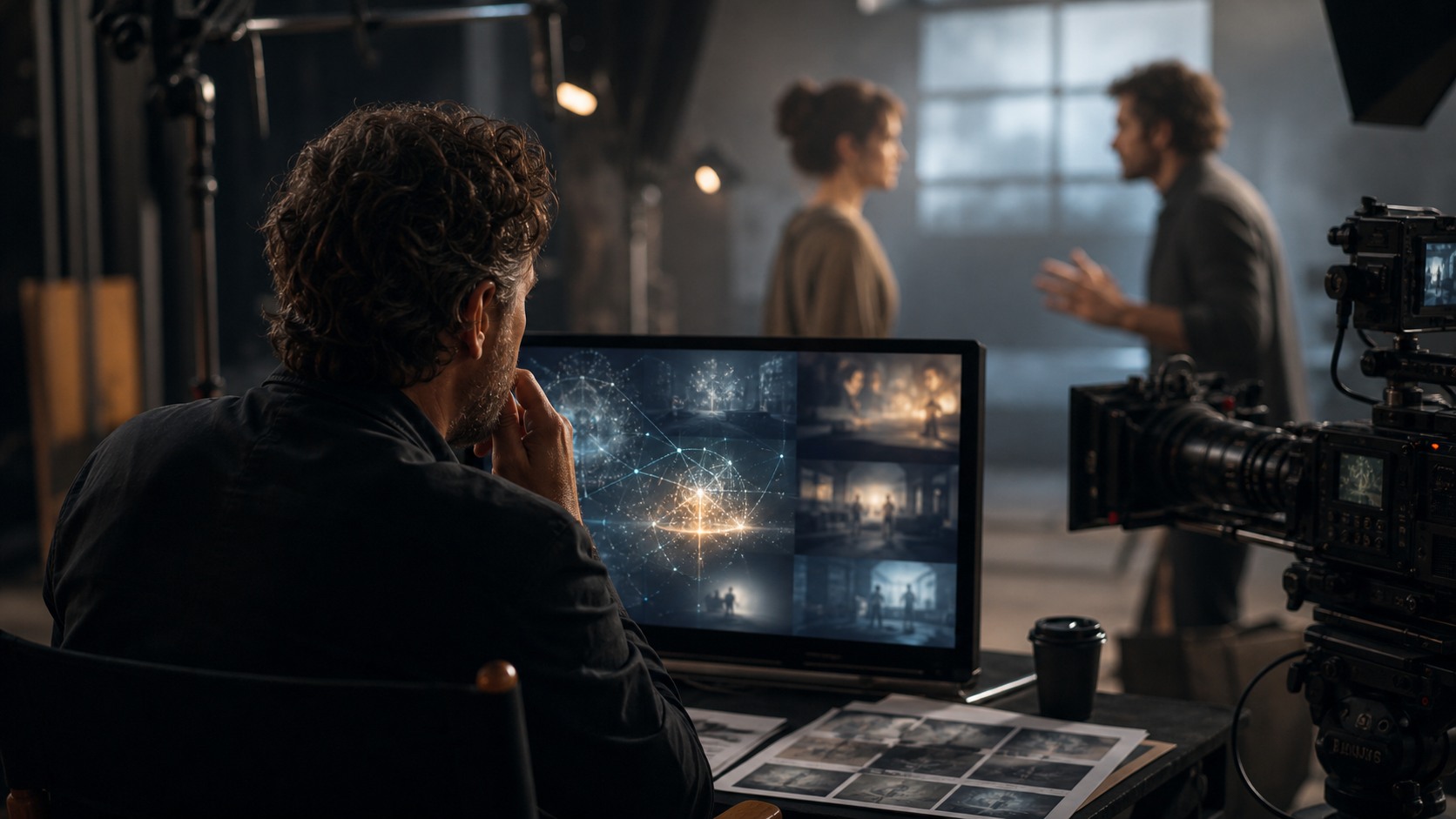
The role of AI in modern film direction is best understood as a support layer across development, pre-production, production, and post-production. AI can help directors see options earlier, organize ideas faster, and communicate with collaborators more clearly. It can assist with script breakdowns, storyboards, visual references, scheduling questions, and edit review. But the director still leads the film’s point of view. AI supports the work; it does not replace the human role of shaping meaning through people and choices.
AI in Development
During development, AI can help directors explore tone, theme, structure, and visual direction. It can summarize script drafts, surface recurring motifs, generate early mood references, or help compare different approaches to a scene. This can make development more visual and organized.
The director should treat these outputs as prompts for thinking. A summary may reveal that a character arc is unclear. A mood image may show that the film’s tone is too familiar. AI helps when it makes the director ask better questions.
Development remains human because the director must decide what the film is trying to say. AI can help examine the material, but it cannot define the director’s reason for making it.
AI in Pre-Production
Pre-production is where AI may have the most visible role. Directors can use it for storyboards, previsualization, shot ideas, look references, location concepts, and department conversations. It can help teams see the film before expensive commitments are made.
AI pre-production work is strongest when it is labeled clearly. A frame might be a tone reference, a camera idea, a design direction, or a rejected experiment. Clear labels prevent collaborators from mistaking rough output for final intent.
The director’s job is to turn AI exploration into a plan. That means narrowing options, choosing priorities, and preparing materials the crew can actually use.
AI in Collaboration
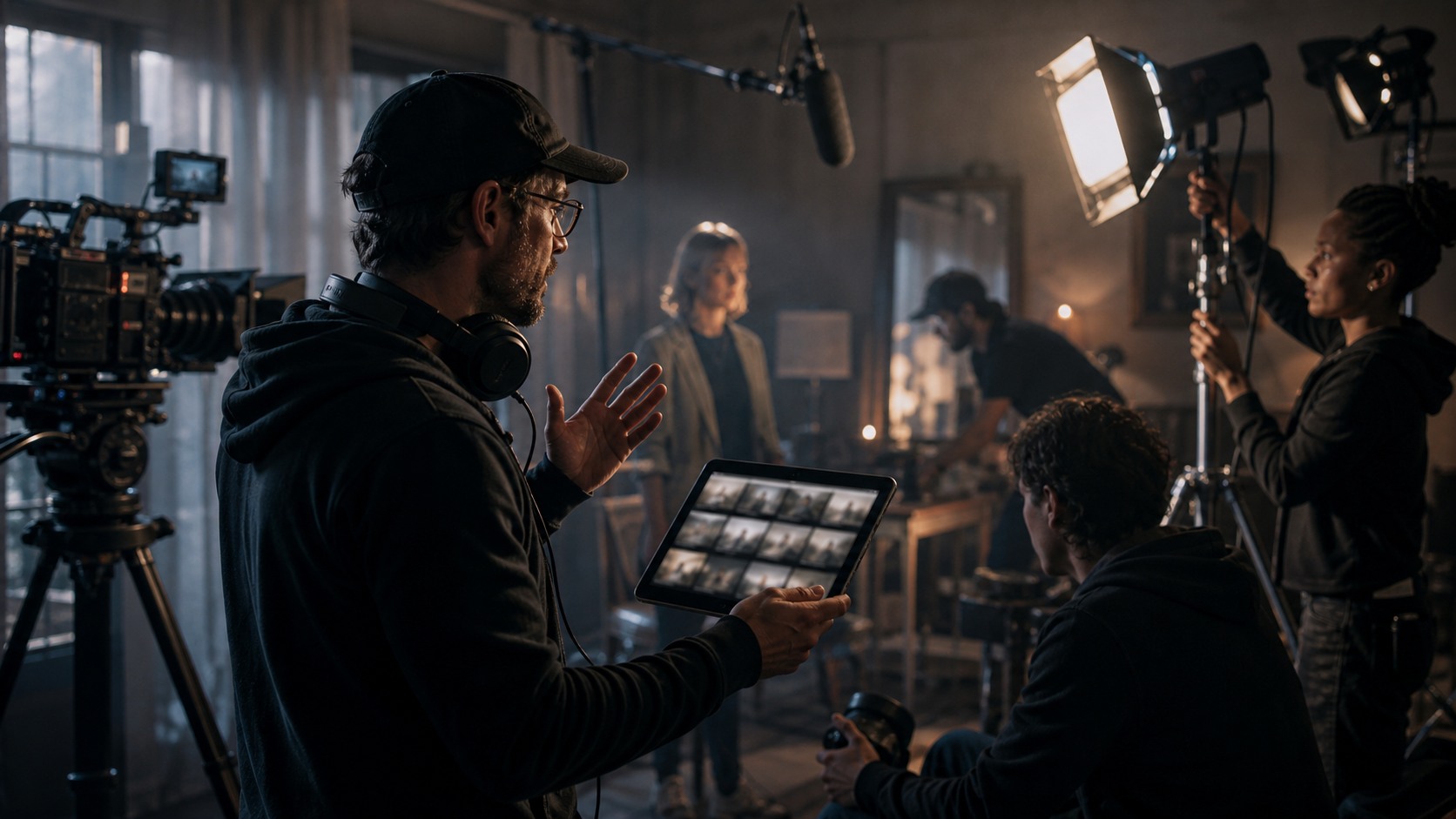
Film direction depends on collaboration, and AI can make collaboration more concrete. A director can show references to a cinematographer, share boards with an editor, discuss design options with production design, or ask a producer to review scope. Shared visuals can reduce guesswork.
The risk is that AI output becomes too dominant. If a director treats generated images as commands, collaborators may stop contributing. That weakens the film. AI references should invite expertise, not replace it.
Modern directors can use AI well by asking departments what the output implies. What would this shot require. What does this frame miss. What would make this idea more filmable.
AI in Production Planning
AI can support production planning by helping directors prepare shot priorities, alternate coverage, location questions, and scene notes. It can help identify which shots are essential and which are optional if time runs short.
It can also help organize information. A director may use AI to summarize rehearsal notes, compare continuity concerns, or prepare questions for the next production meeting. These organizational uses may be less flashy than generated images, but they can reduce mental load.
The role is assistant-like. AI helps prepare the director, but the director still responds to real people and real conditions on set.
AI On Set
On set, AI’s role should be careful and limited. Production is a live environment where attention matters. A director cannot spend all day generating options while actors and crew wait. AI can be useful for quick reference lookup, continuity notes, or alternate planning, but it should not disrupt the human flow.
Any on-set AI use should respect privacy, contracts, and creative trust. Recording, analyzing, or generating around performers raises questions that productions should settle before the shoot.
The strongest on-set role may be preparation rather than real-time control. The better AI has helped before the shoot, the less it needs to intrude during the shoot.
AI in Post-Production
In post-production, AI can help directors review transcripts, search footage, organize notes, explore temporary sound ideas, test visual effects concepts, or compare edit summaries. These tools can make the director’s review process more efficient.
The final edit still requires human taste. AI may suggest a shorter version, but the director and editor decide whether the rhythm is right. AI may identify patterns, but it cannot know what silence should feel like in a specific scene.
Post-production is where the whole film becomes visible. AI can help manage complexity, but it cannot replace the director’s response to the assembled work.
AI and Director Workload
Directors carry many kinds of workload: creative, emotional, logistical, and communicative. AI may reduce some administrative or exploratory burden. It can draft summaries, organize options, and create starting points for discussion.
But AI can also add workload if it creates too many choices. More options mean more review. More generated material means more organization. The director needs boundaries so the tool does not become another source of noise.
A modern AI workflow should reduce confusion. If it makes the director less focused, it is being used poorly.
AI and Ethics
Ethics are part of modern direction because AI can touch likeness, voice, style, labor, and disclosure. Directors should understand when AI use affects collaborators and when consent is needed. They should also know how public-facing materials were made.
Ethical direction does not mean avoiding every AI tool. It means using tools with clarity and respect. Actors, artists, crew, clients, and audiences may all have legitimate questions about synthetic material.
A director who uses AI responsibly can build trust. A director who hides or misunderstands AI use may create conflict later.
How the Role Will Evolve
AI’s role in film direction will likely grow as tools become more integrated with writing, planning, production, and post. Directors may use AI assistants for research, continuity, storyboards, scheduling alternatives, and visual development. Some of this will become ordinary.
The director’s core role may become more focused on judgment. When tools create more options faster, the director must know what to keep, what to reject, and what to ask next. Taste becomes more important under abundance.
The future director may not be the person who does everything manually. The future director is still the person who knows what the film needs.
Where AI Should Stay in the Background
Some of AI’s best directing support may be quiet. A tool that organizes notes, finds a continuity concern, prepares a meeting summary, or compares storyboard versions may not look dramatic, but it can help the director stay present with actors and collaborators. Background support is often healthier than constant visible generation.
This matters because directing requires attention. If AI tools pull the director into endless prompts, dashboards, and alternate outputs, they can weaken the very focus they are meant to support. A good workflow should reduce distraction, not add a new performance of productivity.
Directors should decide which AI tasks can happen before meetings, between production days, or during post review. Not every tool belongs in the middle of a creative conversation. Sometimes the best use is preparation that lets the human conversation go deeper.
AI should also stay in the background when performance trust is at stake. Actors need to feel that a director is watching and listening to them, not comparing them to a synthetic idea. The tool should support the director’s preparation, not replace the director’s attention.
The modern role of AI may therefore be less glamorous than the hype suggests. Its strongest contribution may be helping directors carry complexity more gracefully while keeping the human work at the center.
How Directors Can Introduce AI to a Team
Directors should introduce AI use clearly rather than casually. If the production will use AI for references, storyboards, summaries, or post review, collaborators should know what that means. Clarity prevents suspicion and gives people a chance to raise concerns early.
A simple explanation can cover the purpose, boundaries, and approval process. The director might say AI will be used for internal mood exploration, not for final actor likeness. Or AI will help organize notes, but performance decisions will remain between director and actor. These boundaries matter.
Different collaborators may care about different issues. Actors may care about likeness and performance data. Artists may care about credit and reference use. Producers may care about legal exposure. Editors may care about whether AI suggestions will interfere with the cut. Listening to these concerns is part of leadership.
Introducing AI well can make the workflow feel collaborative instead of imposed. It shows that the director is using tools thoughtfully and that human expertise remains valued.
The role of AI in modern direction is therefore also a communication issue. The tool is easier to use responsibly when the team understands where it belongs.
How AI Changes Director Preparation Materials
Director preparation materials may become more layered with AI. A director’s folder might include script breakdowns, tone references, generated boards, location photos, rehearsal notes, edit questions, and department comments. The challenge is making those materials usable rather than overwhelming.
A preparation packet should separate approved direction from exploration. If a frame is only a mood reference, it should say so. If it is a target composition, it should say that too. This distinction helps collaborators respond correctly and prevents rough AI output from being mistaken for a locked plan.
AI can also help keep materials updated. Summaries, comparison notes, and version lists can reduce confusion as the plan changes. But the director should still review the packet personally. Sending unreviewed AI summaries to a team can spread errors quickly.
The modern role of AI is therefore partly editorial. It helps collect and organize, but the director edits the preparation materials into a clear signal. The team does not need every thought. It needs the right thoughts at the right time.
Why the Role Depends on the Project
AI will not have the same role on every film. A small drama may use it mainly for notes and references. A science-fiction short may rely on it heavily for world exploration. A documentary may use it for transcripts and research organization while avoiding synthetic imagery.
Directors should define the role of AI project by project. The tool should match the film’s needs, ethics, collaborators, and budget. A thoughtful use on one production may be distracting or inappropriate on another.
This flexibility is important. AI is not a directing philosophy by itself. It is a set of tools that should be shaped by the film.
The Practical Role Today
Today, AI’s practical role is to help directors prepare, see, compare, communicate, and organize. It is strongest before production and during review-heavy stages. It is weakest when asked to replace human trust, performance direction, or final meaning.
Directors should adopt AI where it helps the film become clearer. They should resist it where it creates generic choices, ethical uncertainty, or distraction. The role of AI is not fixed; it depends on the discipline of the director using it.
Modern film direction can include AI without becoming AI-led. The director remains the person who turns tools, collaborators, constraints, and ideas into a finished cinematic experience.