
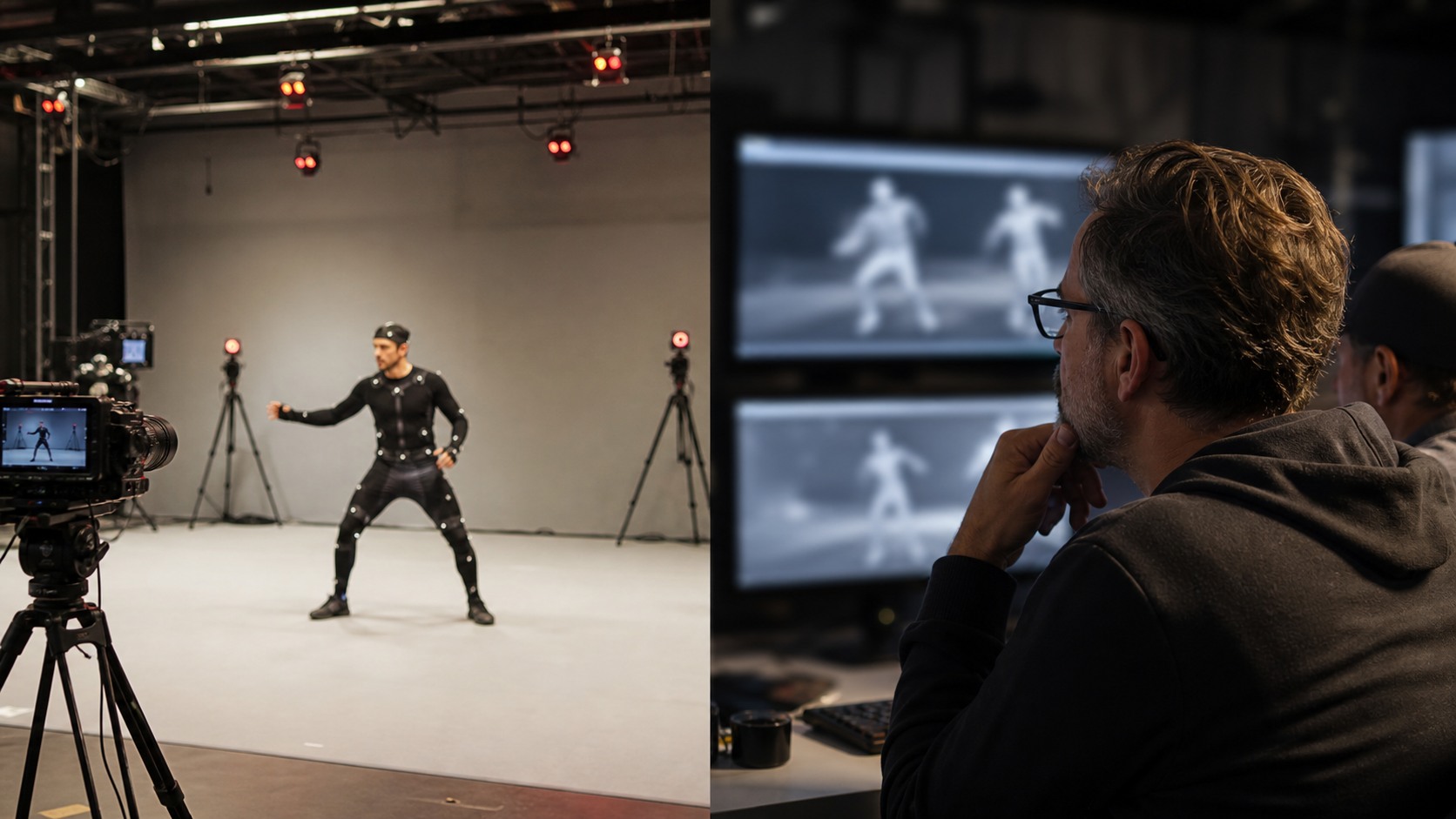
Generative Video and Motion Capture Solve Different Film Problems
Generative video models and motion capture both help filmmakers create movement, but they begin from very different creative sources. Motion capture records a real performer and turns that performance into usable motion data. Generative video models create or transform motion by predicting visual patterns from prompts, references, or learned examples. One approach starts with a body in a room. The other starts with a model producing a possible image sequence. For filmmakers, the question is not which one is universally better. The question is which method gives the scene the right mix of performance truth, visual flexibility, budget control, and production reliability.
What Motion Capture Gives Filmmakers
Motion capture gives filmmakers a performed foundation. An actor, stunt performer, dancer, or creature performer moves in a capture space while cameras or sensors record body position and timing. That data can then drive an animated character, digital double, or visual effects element.
The biggest advantage is human intention. A performer can hesitate, accelerate, breathe, listen, and react. Those choices are not generic movement. They come from a body responding to direction, scene context, and physical rhythm.
What Generative Video Models Offer
Generative video models offer speed and breadth. A filmmaker can explore a rough movement idea, alternate camera treatment, surreal transition, crowd beat, or stylized action without first booking a capture stage. The result may be useful as a reference, a pitch test, or an early previs experiment.
The strength is possibility. A model can show several visual directions quickly, especially when the team is still deciding what the sequence should feel like. The weakness is that the motion may not come from a real performance.
Performance Realism
Motion capture usually has the edge when performance realism matters. If a scene depends on a specific actor's timing, physicality, or emotional transition, recording a performer gives the director something grounded to shape.
Generative video can imitate believable motion, but it may miss the inner logic of acting. A generated character can move smoothly while failing to seem motivated. The body may cross a room without revealing fear, confidence, fatigue, or desire.
Speed and Early Exploration
Generative video is often faster for early exploration. A director can test a creature movement, action direction, or camera idea before deciding whether the sequence deserves more expensive work. This can be useful in development, pitching, and pre-production.
Motion capture requires planning, people, gear, cleanup, and post-processing. That structure is valuable when the team knows what it needs, but it can be heavy when the question is still exploratory.
Creative Control
Motion capture gives control through direction. The director can ask the performer to move slower, feel heavier, wait before turning, or react to an imagined threat. The result changes because a human adjusts the performance.
Generative video gives control through prompting, references, constraints, and iteration. That control can be powerful, but it is indirect. The filmmaker asks the system for a result, then judges whether the model interpreted the request well enough.
Cost Considerations
Motion capture can be expensive because it may require a stage, performers, technicians, cleanup artists, and integration work. For complex action or performance-driven animation, that cost may be justified because the captured foundation saves time later.
Generative video can reduce early exploration costs, but it does not remove final production costs. A generated test may still require artists, editors, VFX teams, legal review, and human cleanup before it becomes part of a serious workflow.
Physical Accuracy
Motion capture records real physical behavior, so gravity, timing, foot contact, balance, and body mechanics often begin in a stronger place. Cleanup is still needed, but the movement has a real-world source.
Generative video can create motion that looks plausible at first glance yet slips under closer review. Feet may slide, limbs may drift, weight may disappear, or the camera may move through impossible space.
Stylization and Impossible Motion
Generative video can be useful when the goal is not strict realism. Dreams, transitions, abstract memories, stylized action, and impossible camera moves may benefit from a model's ability to create visual surprises.
Motion capture can also be stylized, but it begins with performed data. That can be a strength or a limitation depending on the scene. Sometimes the director wants the physical truth of a performer. Sometimes the director wants something no body could do.
Actor and Likeness Questions
Motion capture usually has clearer performer involvement because a person is recorded for the role. Contracts, credits, and consent can be handled as part of the production process.
Generative video raises different questions. If the output resembles a performer, borrows from reference footage, or suggests a synthetic double, the production needs clear rules around consent, usage, and disclosure.
Editing and Shot Integration
A motion capture performance still has to work in the edit. The captured movement may need retiming, camera adjustment, animation cleanup, or emotional shaping to fit the sequence.
Generated video also needs editorial review. A clip may look impressive alone but fail when cut beside live-action footage. Screen direction, rhythm, continuity, and lighting must be tested in context.
When to Choose Motion Capture
Choose motion capture when the scene depends on performance, precise body mechanics, stunt logic, actor-specific movement, or repeatable animation control. It is especially useful when the production already knows what movement it needs.
Motion capture is also strong when many shots need consistent character motion. Once a performance pipeline is established, the team can refine movement across a sequence with more continuity.
When to Choose Generative Video
Choose generative video when the team needs fast ideation, mood exploration, surreal motion, temporary references, or alternate versions before committing to a pipeline. It is valuable when the question is what could this feel like.
It can also help small teams communicate ideas earlier. A rough generated motion reference may help a producer, editor, or VFX supervisor understand what the director is imagining.
A Hybrid Workflow
Many productions may use both. Generative video can help explore the concept, motion capture can record the performance, and artists can refine the final animation or VFX shot. The methods are not enemies.
A hybrid workflow works best when each tool has a clear role. Use generative video for possibility, motion capture for performed foundation, and human craft for final cinematic control.
Previs Before Capture
Generative video can be useful before a motion capture session because it helps the director clarify what kind of movement should be recorded. A rough generated clip can suggest whether the action needs speed, hesitation, weight, fear, comedy, or elegance.
That reference can make the capture day more focused. Instead of arriving with only verbal instructions, the director can show a movement target and then ask the performer to improve it with real physical choices.
Cleanup After Capture
Motion capture is not automatically finished motion. Data cleanup, retargeting, animation polish, facial work, and shot integration can all take time. A captured performance may need significant adjustment before it feels right in the final frame.
This matters when comparing costs. Generative video may seem cheaper and mocap may seem expensive, but both methods can create downstream work. The honest comparison includes cleanup, revision, approval, and integration.
Creature and Nonhuman Movement
Nonhuman movement complicates the comparison. Motion capture can record a performer acting as a creature, but the body may not match the final anatomy. Generative video can imagine impossible movement, but it may ignore believable weight or biology.
A strong creature workflow often combines references: animal study, performer capture, animation expertise, and generated exploration. The director should judge whether the movement feels alive, not only whether it looks unusual.
Data and Ownership
Motion capture produces data tied to a performer and a production. Generative video may produce outputs based on prompts, references, or model behavior that can be harder to trace. Both raise ownership questions, but the questions are different.
Productions should decide how motion data, generated tests, likeness references, and final assets are stored and credited. Clear records prevent confusion when shots are revised months later.
How Producers Should Evaluate the Choice
Producers should evaluate not only the sticker price of a tool, but the reliability of the path to approval. A fast generated test is valuable if it leads to a decision. It is less valuable if the team generates hundreds of options without committing.
Motion capture may cost more upfront, but it can reduce uncertainty for performance-driven sequences. The right budget choice is the one that reduces risk for the specific scene.
Audience Perception
Audiences rarely care which method created the movement. They care whether the moment feels believable, expressive, and connected to the film. A technically advanced workflow can still fail if the movement does not carry emotion.
This is a useful reminder for directors. Tool debates matter during production, but the finished scene matters more. The method should disappear behind the performance and story.
Director Review Workflow
A director comparing the two methods should review the same story beat through both lenses. First, ask what the movement needs to communicate: fear, effort, confidence, impact, hesitation, grace, or transformation. Then ask which method gives the team the clearest path to that feeling. This prevents the decision from becoming a technology contest. The question stays attached to the scene.
The review should include at least three people: someone focused on performance, someone focused on technical feasibility, and someone focused on the edit. A performer or animation lead may see body truth. A VFX supervisor may see pipeline risk. An editor may see whether the movement will cut. Those perspectives keep the choice practical.
It also helps to define what kind of approval is needed. A pitch test may only need to communicate direction. A previs test may need accurate timing and geography. A final shot needs far stricter review. Generative video and motion capture can both be useful, but the standard changes depending on how the material will be used.
Training Teams to Use Both
Teams that use both methods need shared vocabulary. If one person says realistic, they may mean physical accuracy. Another may mean emotional believability. Another may mean that the motion matches the lighting and camera. Clarifying these words saves time during review.
A useful practice is to separate movement notes from image notes. The generated clip may have beautiful lighting but weak motion. The capture take may have strong body behavior but need visual translation. When feedback is specific, the team can decide whether to regenerate, recapture, animate, or edit around the problem.
This kind of discipline makes the tools less intimidating. Each method becomes one route toward a filmable result. The team learns when to use speed, when to use performance capture, and when to stop testing and commit.
The Practical Takeaway
Generative video models are strongest when filmmakers need speed, variation, and exploratory motion. Motion capture is strongest when filmmakers need performed truth, physical accuracy, and controllable animation data.
The best choice depends on the scene. A creature test, pitch clip, or surreal transition may begin with generative video. A performance-driven digital character may need motion capture.
Filmmakers should choose the method that protects the story, not the method that sounds newest. Movement only matters when it serves the shot, the edit, and the audience's belief.


