A New Chapter in the Story of Cinema
Cinema has always evolved alongside technology. From silent films to sound, black-and-white to color, analog to digital, each leap has reshaped how stories are imagined and shared. Today, artificial intelligence is ushering in the next transformation. AI filmmaking is not simply about faster tools or cheaper workflows; it represents a fundamental shift in how ideas are generated, images are created, and stories are assembled. For beginners, the topic can feel intimidating, wrapped in buzzwords and speculation. In reality, AI filmmaking is a practical, creative toolkit that is already influencing every stage of film production and opening doors to voices that once struggled to be heard.
A: No, it supports creative decision-making.
A: No, it benefits independent creators greatly.
A: Yes, many tools are beginner-friendly.
A: It can assist, but humans shape stories.
A: Ethics depend on transparency and consent.
A: Costs are often lower than traditional methods.
A: Yes, especially with rough cuts and pacing.
A: Only if used without intention.
A: It’s already part of the present.
A: With small tools integrated into existing workflows.
Defining AI Filmmaking in Plain Terms
AI filmmaking refers to the use of machine learning models and intelligent algorithms to assist, augment, or automate parts of the filmmaking process. These systems learn patterns from vast datasets of images, videos, sounds, scripts, and editing styles, then use that learning to generate or modify content. Rather than replacing filmmakers, AI acts as a creative collaborator, handling tasks that are time-consuming, technically complex, or expensive, while humans remain responsible for vision, meaning, and emotional truth.
At its core, AI filmmaking blends computer science with cinematic craft. A director may still shape the story and performances, but AI can help visualize scenes before they are shot, suggest edits based on narrative pacing, generate visual effects, clean up audio, or even create entire synthetic environments. The result is a filmmaking landscape that is more accessible, iterative, and experimental than ever before.
How Artificial Intelligence Learns to Make Film
To understand AI filmmaking, it helps to grasp how these systems learn. Most filmmaking tools rely on machine learning, particularly deep learning models trained on enormous collections of media. These models do not “understand” stories the way humans do. Instead, they identify statistical patterns: how light falls on faces, how dialogue aligns with emotion, how shots are cut together to create rhythm.
When trained properly, AI can predict what a believable frame might look like or how a scene might flow. This predictive ability allows filmmakers to generate images from text descriptions, upscale old footage, simulate camera movements, or analyze scripts for structure and tone. The intelligence is not creative in a human sense, but it becomes powerful when guided by human intent.
AI in Pre-Production: From Idea to Blueprint
Pre-production is where ideas are tested and refined, and AI has become a powerful ally at this stage. Writers can use AI-assisted tools to explore story concepts, develop characters, or experiment with dialogue variations. While the human writer remains the author, AI can help overcome creative blocks by offering alternatives that spark new directions.
Storyboarding and concept art have also been transformed. Instead of weeks of illustration, filmmakers can generate visual references in minutes, helping teams align on mood, color, and composition early in the process. Scheduling and budgeting tools powered by AI analyze scripts to predict production needs, reducing costly surprises. For beginners with limited resources, this means entering production with greater confidence and clarity.
Production Reimagined Through Intelligent Tools
During production, AI quietly enhances efficiency and precision. Cameras equipped with intelligent autofocus and exposure systems track subjects more accurately, even in complex lighting conditions. Virtual production environments allow actors to perform in front of LED walls displaying AI-generated or AI-enhanced backgrounds, reducing the need for location shoots and heavy post-production.
Performance capture and facial animation benefit enormously from AI. Subtle expressions can be mapped and refined, creating digital characters that feel emotionally authentic. Audio recording is improved through real-time noise reduction and voice isolation, allowing filmmakers to capture usable sound in environments that once would have been unusable.
Post-Production: Where AI Truly Shines
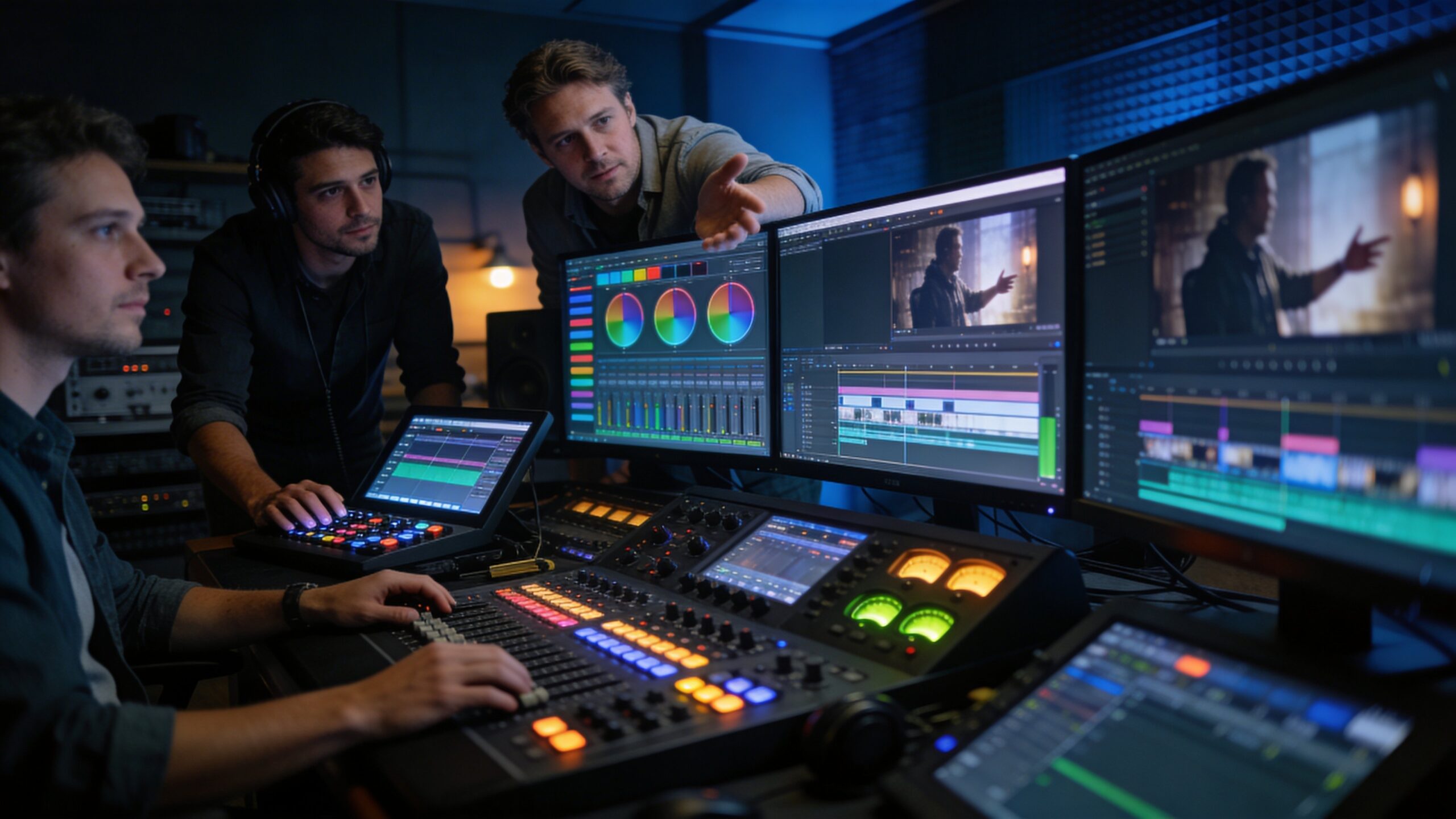
Post-production is currently the most visible arena for AI filmmaking. Editing software now analyzes footage to identify the best takes, match shots, and suggest cuts based on pacing and continuity. Color grading tools learn from reference films and apply cinematic looks consistently across scenes, saving hours of manual adjustment.
Visual effects workflows have been accelerated through AI-powered rotoscoping, background removal, and object tracking. Tasks that once required frame-by-frame labor can now be completed in minutes. Sound design has also evolved, with AI capable of generating ambient audio, cleaning dialogue, and even recreating voices under strict ethical controls. Companies such as Adobe have integrated AI deeply into editing and visual tools, while platforms like Runway focus specifically on generative video and effects, signaling how central AI has become to modern post-production.
Generative Video and the Rise of Synthetic Media
One of the most talked-about aspects of AI filmmaking is generative video. These systems can create moving images from text prompts, still images, or rough sketches. While early results were abstract or uncanny, quality has improved rapidly. Filmmakers can now generate establishing shots, dream sequences, or concept footage without traditional cameras.
Synthetic actors and environments raise important creative and ethical questions, but they also expand storytelling possibilities. Independent creators can visualize ambitious worlds that once required blockbuster budgets. Used responsibly, generative video becomes a sketchpad for imagination rather than a replacement for human performance.
The Role of the Filmmaker in an AI-Driven World
As tools become more capable, the role of the filmmaker evolves rather than disappears. Creativity shifts from manual execution to decision-making, curation, and storytelling judgment. Knowing what to ask of AI, how to refine its outputs, and when to override it becomes a core skill.
Directors still guide tone and emotion. Editors still shape meaning through rhythm and juxtaposition. Cinematographers still define visual language. AI accelerates the “how,” but humans remain responsible for the “why.” This balance is what ensures films remain culturally and emotionally resonant.
Democratization of Film Production
One of the most profound impacts of AI filmmaking is accessibility. Historically, filmmaking required expensive equipment, large crews, and institutional support. AI tools lower these barriers, enabling individuals and small teams to produce high-quality work from anywhere in the world.
This democratization diversifies the stories being told. Voices from underrepresented communities gain the ability to visualize their narratives without waiting for permission or funding. As a result, audiences encounter fresh perspectives and experimental forms that challenge traditional norms.
Ethical Considerations and Creative Responsibility
With great power comes responsibility, and AI filmmaking is no exception. The ability to manipulate images and voices raises concerns about consent, authorship, and misinformation. Ethical filmmaking requires transparency about how AI is used and respect for performers’ rights.
Industry discussions increasingly focus on responsible datasets, clear attribution, and safeguards against misuse. Beginners entering AI filmmaking should view ethics not as a constraint, but as part of professional craft. Trust between creators and audiences is essential for the long-term health of cinema.
Learning AI Filmmaking as a Beginner
For newcomers, the best approach is incremental exploration. Start by integrating AI tools into familiar workflows rather than attempting to automate everything at once. Experiment with AI-assisted editing, color grading, or sound cleanup. Observe where the technology genuinely enhances creativity and where human judgment remains superior.
Educational resources are expanding rapidly, with tutorials, communities, and open-source projects making learning more accessible. Tools built on platforms such as OpenAI or engines like Unreal Engine demonstrate how AI intersects with real-time rendering and storytelling, offering practical entry points for beginners.
The Business of Film in the Age of AI
AI filmmaking also reshapes the economics of the industry. Production timelines shorten, budgets become more flexible, and new distribution models emerge. Content creation scales across platforms, from traditional theaters to streaming services and immersive experiences.
For professionals, this shift demands adaptability. Understanding AI workflows becomes a competitive advantage, while those who resist change risk obsolescence. At the same time, unions, studios, and creators continue negotiating how AI fits into fair labor practices, ensuring innovation benefits all participants.
Looking Ahead: The Future of AI and Cinema
The future of AI filmmaking is not a single destination, but an ongoing dialogue between technology and art. As models grow more sophisticated, they will better understand narrative context, emotional arcs, and visual symbolism. Filmmakers will gain tools that feel less like software and more like creative partners.
Yet the essence of cinema will remain human. Stories matter because they reflect our fears, hopes, and identities. AI expands the palette with which those stories are painted, but it does not replace the storyteller. Instead, it challenges filmmakers to think differently, to experiment boldly, and to reimagine what film can be.
Final Thoughts: Embracing the Next Evolution
AI filmmaking represents the next evolution in a long history of cinematic innovation. For beginners, it offers an exciting invitation to participate in film creation without traditional barriers. By understanding what AI can do, respecting its limits, and grounding every project in human intention, filmmakers can harness this technology to tell richer, more diverse stories. The future of film is not about machines taking over creativity. It is about humans learning to collaborate with intelligent tools to expand imagination itself.