
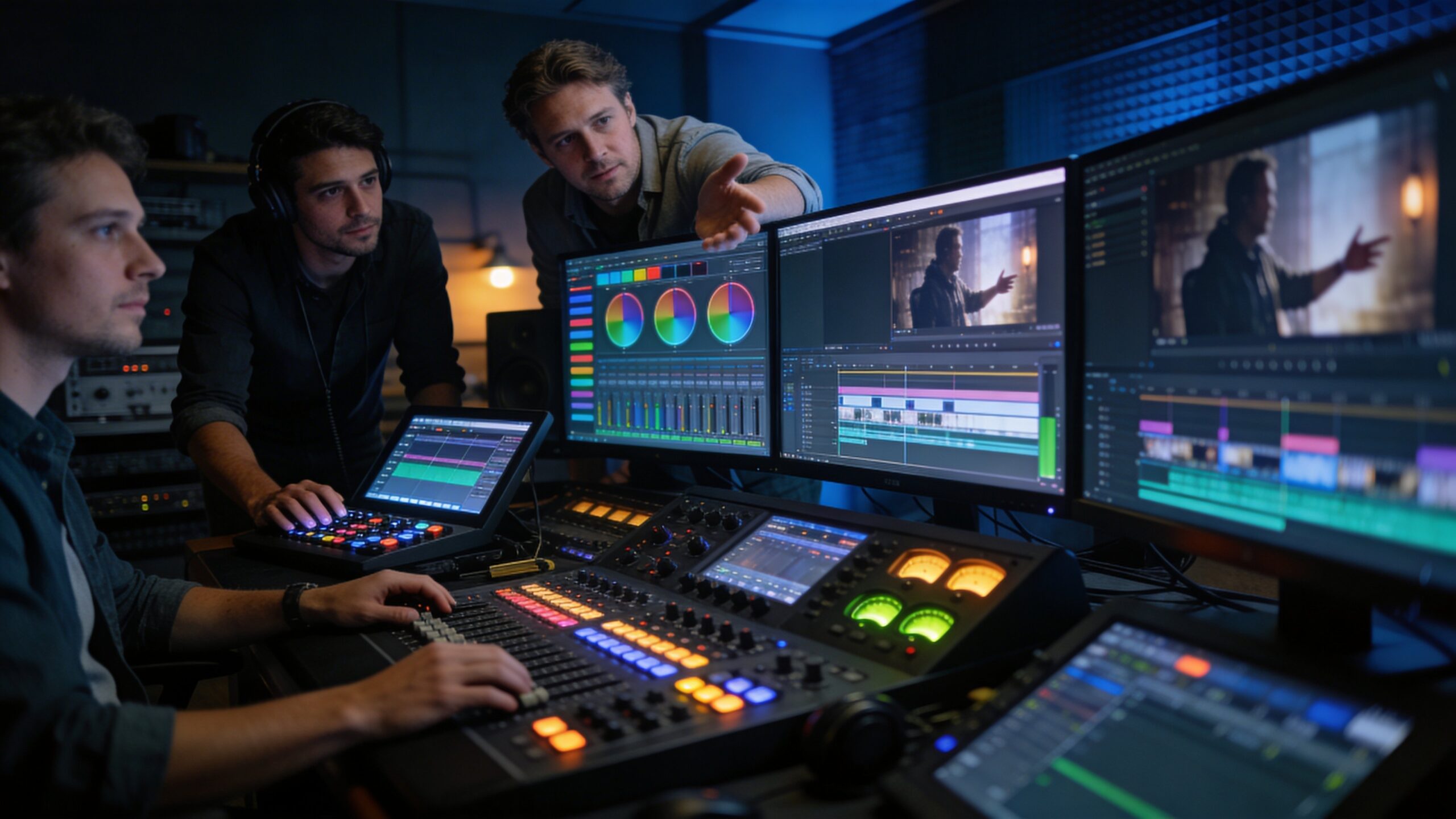
Artificial intelligence has moved from the edges of filmmaking into the center of the creative process. What once sounded like a futuristic add-on is now becoming a practical layer in how films are imagined, planned, produced, edited, marketed, and delivered. In the modern filmmaking workflow, AI is not replacing the heart of cinema. It is becoming part of the machinery around it, helping directors, producers, editors, writers, designers, and marketers move faster through complex tasks while opening new creative possibilities. The film industry has always embraced tools that expand what storytellers can do. Cameras became lighter, editing became digital, visual effects became more seamless, and distribution became global. AI fits naturally into that long history of innovation. Its role is not just about automation. It is about enhancement. It can help organize research, generate concept ideas, test visual directions, sort through footage, improve sound, refine color, predict audience interest, and streamline the many invisible steps that sit between inspiration and the finished screen experience. What makes AI especially important in today’s filmmaking environment is the pressure modern creators face. Productions need to move quickly. Budgets are tightly watched. Audiences expect polished visuals, clean sound, memorable marketing, and content tailored for multiple platforms. Independent filmmakers often need studio-level efficiency without studio-level resources. AI enters this landscape as a toolset that can support both major productions and small creative teams. It can reduce friction in the workflow, freeing artists to spend more time on storytelling decisions instead of repetitive technical tasks. Still, AI’s place in filmmaking is not simple. It raises questions about authorship, originality, labor, ethics, and the meaning of craft. Some filmmakers see it as a powerful assistant. Others worry it could flatten creativity if used carelessly. The truth lies somewhere in the middle. AI works best when it is guided by human taste, vision, emotion, and judgment. It can suggest, organize, simulate, and accelerate, but it does not feel suspense, understand heartbreak, or know why one pause in a performance can carry more weight than a page of dialogue. Those choices remain deeply human.
A: No, it is mainly being used to assist with research, planning, editing, cleanup, and workflow efficiency.
A: Common areas include script breakdowns, transcription, sound cleanup, shot organization, and post-production support.
A: It can generate ideas and draft material, but strong scripts still need human voice, taste, and emotional insight.
A: Yes, especially because it can help small teams work faster and produce more polished materials on tighter budgets.
A: Not really; it can organize and search footage quickly, but shaping story rhythm still depends on the editor.
A: Often yes, especially for noise reduction, voice isolation, and dialogue clarity.
A: Absolutely, it helps generate campaign ideas, audience targeting insights, and multiple content variations.
A: Copyright, consent, labor impact, performer likeness rights, and overreliance on machine-generated work.
A: Sometimes, but many uses are behind the scenes in planning, cleanup, and workflow organization.
A: Use it to support efficiency and experimentation while keeping human storytelling decisions in charge.
AI in the Development Stage
The filmmaking workflow often begins long before a camera rolls. Development is where ideas are explored, scripts are shaped, characters are refined, and projects are positioned for funding or production. This stage can be slow, uncertain, and labor-intensive, which is why AI is becoming increasingly useful here. Writers and development teams can use AI to help brainstorm loglines, compare story structures, generate alternate scene concepts, and organize research. For a filmmaker developing a historical drama, science-fiction thriller, or documentary, AI can help sort large amounts of reference material into more usable categories. It can assist with early treatment drafting, character backstory options, tonal experiments, and pitch language. Rather than replacing the writer, it can serve as a fast-moving thought partner that helps surface possibilities. AI can also support script analysis. Producers and development executives often need to evaluate pacing, character balance, genre cues, dialogue density, and scene distribution. AI tools can identify patterns in a screenplay and reveal where certain elements may be too thin, too repetitive, or structurally uneven. That does not mean the software decides what is good. It means filmmakers get another lens through which to inspect their material before committing time and money to production. Pitch preparation is another area where AI fits naturally. A film package often includes a synopsis, treatment, mood references, lookbook language, and audience positioning. AI can help transform raw creative notes into more polished presentation materials. It can assist independent creators who may not have large development teams but still need to present their projects in a professional and compelling way.
Pre-Production Gets Smarter and Faster
Pre-production is where filmmaking becomes highly logistical. Scheduling, budgeting, location planning, casting coordination, shot listing, storyboarding, and department communication all collide in a tightly managed window of time. AI has begun to make this stage more efficient by helping filmmakers process complexity at scale. One of the clearest advantages of AI in pre-production is organization. Large productions manage an enormous amount of moving information, from costume breakdowns to scene requirements to weather-sensitive location planning. AI-powered tools can quickly analyze scripts and extract production elements such as props, character appearances, location needs, and day-night scenes. This helps assistant directors, line producers, and production managers build schedules and resource plans with greater speed.
Storyboarding and visual development have also changed. Directors and cinematographers can use AI-assisted image generation and visual reference tools to explore different moods, framing ideas, production design styles, and lighting concepts before committing them to a final visual language. These tools can accelerate conversations between departments by giving everyone a clearer sense of the intended look and tone. Instead of relying only on verbal descriptions, a team can react to visual directions much earlier in the process. Casting and audience testing may also be influenced by AI in early planning. Some systems can analyze script tone and genre positioning to help teams better understand comparable projects or audience expectations. Used carefully, this can support decision-making around marketing strategy or financing conversations. Used carelessly, it can become overly predictive and restrictive. The best use is to inform human choices, not replace instinct or creative risk.
AI on Set During Production
Production is where artistic vision meets real-world pressure. Time is limited, costs rise quickly, and every department is working in sync. On set, AI is most useful when it reduces friction without interrupting the creative rhythm of filmmaking. AI can help production crews monitor continuity, camera metadata, and footage organization in real time. This is especially valuable on projects generating large volumes of digital material each day. Tools can tag shots, identify faces or locations, flag technical issues, and improve the searchability of footage for post-production. That means editors and assistant editors can begin working more efficiently even while shooting is still underway. Virtual production is another major area where AI is influencing modern filmmaking. In environments that use LED volumes, real-time rendering, or digitally enhanced sets, AI can support background generation, environment refinement, and rapid iteration of visual elements. This helps filmmakers build worlds faster and with greater flexibility. Directors can test visual choices earlier instead of waiting until post-production to discover whether a scene fully works.
AI also supports on-set sound and image enhancement. Noise detection, exposure analysis, focus review, and stabilization previews can give crews immediate feedback. In a demanding production schedule, these tools can help catch small technical problems before they become expensive fixes later. This does not remove the need for experienced cinematographers, camera operators, or sound teams. Instead, it gives them more data and more control. For smaller productions, AI can act as a force multiplier. Independent filmmakers often operate with lean crews, which makes time-saving tools incredibly valuable. If AI helps speed up shot logging, script supervision, equipment tracking, or preview editing, it can expand what a small team is capable of achieving within a limited budget.
Editing and Post-Production Transformation
Post-production may be where AI has made the most visible impact so far. Editing, sound design, color correction, visual effects, subtitling, localization, and versioning all involve detailed technical labor. AI tools are reshaping how quickly these processes can move. In editing, AI can sort footage, detect usable takes, transcribe dialogue, sync audio, identify speakers, and create searchable databases of scenes and lines. This can save editors and assistants an enormous amount of time. Instead of manually hunting through endless clips, teams can search by spoken phrase, camera setup, character, or action. That does not edit the film for them, but it removes friction from the editing process and allows more energy to go toward pacing, rhythm, and emotional structure. Sound work has also been transformed. AI tools can remove background noise, isolate dialogue, repair damaged recordings, smooth audio inconsistencies, and help create cleaner mixes. This is especially useful for documentaries, independent productions, or location shoots where perfect recording conditions are not always possible. Dialogue enhancement that once required intensive repair work can now happen far more quickly, giving sound teams a stronger starting point.
Color correction and image cleanup benefit as well. AI can assist with upscaling, noise reduction, match grading, object removal, and facial or environmental enhancement. Again, the human colorist or finishing artist remains essential because final tone and style are creative decisions, not just technical adjustments. But AI can make the technical side of cleanup faster and more flexible. Visual effects departments are also using AI in targeted ways. Rotoscoping, asset generation, simulation assistance, and compositing support can all be accelerated. For films with limited budgets, this can make effects work more accessible. For larger productions, it can reduce repetitive labor and speed up iteration. The danger comes when these gains encourage unrealistic deadlines or expectations. AI can speed parts of the process, but thoughtful visual storytelling still takes time.
AI and the Business Side of Filmmaking
Filmmaking is both an art and an industry. Beyond the camera and the edit suite, films live inside ecosystems of financing, distribution, marketing, audience targeting, and platform strategy. AI is becoming increasingly valuable in this business infrastructure. On the financing side, AI can assist with market analysis, comparative title research, genre trend mapping, and audience segmentation. Producers trying to position a new thriller, romantic drama, documentary, or animated project can use AI-supported insights to better understand where the film may fit in the current marketplace. This can strengthen funding decks, distribution conversations, and release planning.
Marketing is one of the fastest-moving areas for AI adoption. Campaign teams can use AI to test trailer cuts, generate promotional copy variations, organize social media content plans, identify likely audience clusters, and create localized assets for different territories. Modern films are marketed across theaters, streaming platforms, social channels, short-form video, and digital advertising spaces. AI helps teams manage this expanding volume of content more efficiently. Localization and accessibility are also improved by AI. Subtitling, captioning, translation support, dubbing assistance, and audio description can all move faster with machine support. This makes films easier to distribute globally and more accessible to broader audiences. Human review remains crucial for nuance, cultural sensitivity, and quality control, but AI can dramatically reduce the time needed to produce first-pass versions.
The Creative Tension: Tool or Threat?
Whenever a new technology enters a creative field, anxiety follows. Filmmaking is no exception. Many artists worry that AI could lead to generic storytelling, weaker opportunities for human workers, or an overreliance on machine-generated aesthetics. These concerns are real and should not be brushed aside. The biggest creative risk is not that AI will become more powerful than filmmakers. It is that filmmakers may use it lazily. Cinema thrives on specificity, surprise, vulnerability, and personal vision. If creators begin accepting convenient but uninspired outputs, the work may become smoother but less memorable. AI can offer speed, but speed is not the same thing as taste. At the same time, it would be shortsighted to dismiss AI entirely. Many filmmaking tools that are now considered normal once sparked fear. Digital editing, computer-generated imagery, color grading software, and digital cameras all faced skepticism in earlier phases. Over time, the industry learned that the tool itself was not the problem. The deeper question was always how the tool was used. The healthiest view is to treat AI as part of a layered creative process. It can help explore options, reduce tedious work, and expand capability, but it should remain under human direction. Strong filmmakers will use AI the way strong editors use software or strong cinematographers use lenses: as instruments in service of a larger artistic goal.
Ethics, Ownership, and Responsibility
No discussion of AI in filmmaking is complete without addressing ethics. Questions around copyright, training data, performer likeness, voice replication, authorship, consent, and labor protections are becoming central to the conversation. If AI systems are trained on creative work without permission, that raises serious concerns about fairness and ownership. If digital likeness tools recreate an actor’s face or voice without clear consent, that challenges the boundaries of artistic and personal rights. If studios use AI to reduce labor without protecting workers or crediting contributions properly, that changes the social contract of filmmaking.
Responsible use of AI requires transparency. Productions need clear guidelines for where AI is being used, how outputs are reviewed, what data sources are involved, and where human approval is required. Filmmaking is collaborative by nature, and trust is essential. If AI becomes part of that collaboration, then ethical standards must grow alongside the technology. There is also an audience dimension. Viewers may increasingly want to know how films are made and whether certain performances, visuals, or voices were significantly machine-generated. Transparency can help build trust rather than suspicion. Cinema has always evolved, but the emotional connection between storyteller and audience depends on honesty about what kind of work is being presented.
The Future of AI in Filmmaking
Looking ahead, AI will likely become less of a headline and more of an invisible layer inside filmmaking software and production workflows. Instead of asking whether AI belongs in film, the industry may simply assume it is already embedded in many daily tasks. What will matter more is how deliberately creators use it. The most exciting future is not one where AI makes films on its own. It is one where filmmakers gain more power to create ambitious work with fewer barriers. A small team may be able to visualize a larger world. A documentary editor may find the right emotional thread faster. A sound designer may rescue audio that once seemed unusable. A first-time director may build professional presentation materials that help a great story get made.
AI also has the potential to widen access. Filmmaking has historically required expensive tools, specialized labor, and strong industry connections. As AI lowers some technical barriers, more creators may be able to enter the field and express distinctive ideas. That could lead to more diverse stories, new visual styles, and a broader range of voices in the cinematic landscape. Still, the core of filmmaking will remain stubbornly human. Stories matter because they reflect human conflict, longing, fear, humor, love, and imagination. AI can help shape the path from idea to screen, but it cannot replace the human impulse to tell stories that mean something. The director choosing where to hold on a face, the writer deciding what a character refuses to say, the editor finding the moment that breaks an audience open—those are still acts of feeling, not just processing.
Why AI Belongs in the Workflow, Not in Charge of It
The modern filmmaking workflow is crowded, technical, expensive, and increasingly fast-paced. AI fits into this environment because it can relieve pressure in meaningful ways. It can help develop ideas, organize production, support shooting, streamline editing, improve sound and picture, assist marketing, and expand accessibility. It is already becoming part of how many films move from concept to completion. But the real promise of AI in filmmaking is not that it can do everything. Its value lies in doing certain things well enough to give human creators more room to focus on the work that matters most. When used thoughtfully, AI can reduce repetition and amplify possibility. It can make the workflow more efficient without making the art less human. That balance will define the future of cinema. The filmmakers who thrive will not be the ones who chase AI for its own sake. They will be the ones who understand when to use it, when to ignore it, and how to keep storytelling at the center. In that sense, AI does fit into the modern filmmaking workflow. It fits best as a powerful assistant, a creative accelerator, and a behind-the-scenes engine that supports the people who still give film its soul.


