The New Creative Partner Behind the Camera
Artificial intelligence is rapidly becoming one of the most powerful tools in modern visual storytelling. Once associated mainly with automation and data analysis, AI is now stepping into the creative process in ways that are practical, collaborative, and surprisingly inspiring. In film, animation, advertising, game development, and branded content, creators are using AI to help shape ideas before a single frame is shot. That is especially true in storyboarding, previsualization, and production planning, where clarity, speed, and experimentation are essential. What makes AI so valuable in these early stages is not that it replaces directors, artists, or planners. It helps them move faster from concept to visual form. It can turn written ideas into rough imagery, generate alternate scene concepts, organize sequence logic, and help teams preview how a story may unfold before expensive production decisions are made. In an industry where every hour, revision, and delay can affect the final result, AI adds momentum to the planning process.
A: No; it can speed up ideation, but artists still shape cinematic clarity, narrative flow, and emotion.
A: Yes; it helps smaller teams access visual planning tools that were once harder to afford or scale.
A: It is a visual planning method used to preview shot design, movement, timing, and scene geography before filming.
A: It helps teams generate rough ideas faster, compare options, and move from concept to discussion more quickly.
A: Usually no; they work best as creative references, rough boards, or exploration tools during planning.
A: Indirectly yes; better visual planning can reveal costly issues earlier and support smarter production decisions.
A: Yes; shared visual references help writers, directors, designers, and producers align more quickly.
A: Only when speed still allows thoughtful revision; rushed decisions can weaken visual storytelling.
A: It reduces the distance between written ideas and visible concepts during preproduction.
A: Story judgment, emotional tone, visual taste, and the final creative decisions should remain in human hands.
Why Early-Stage Planning Matters More Than Ever
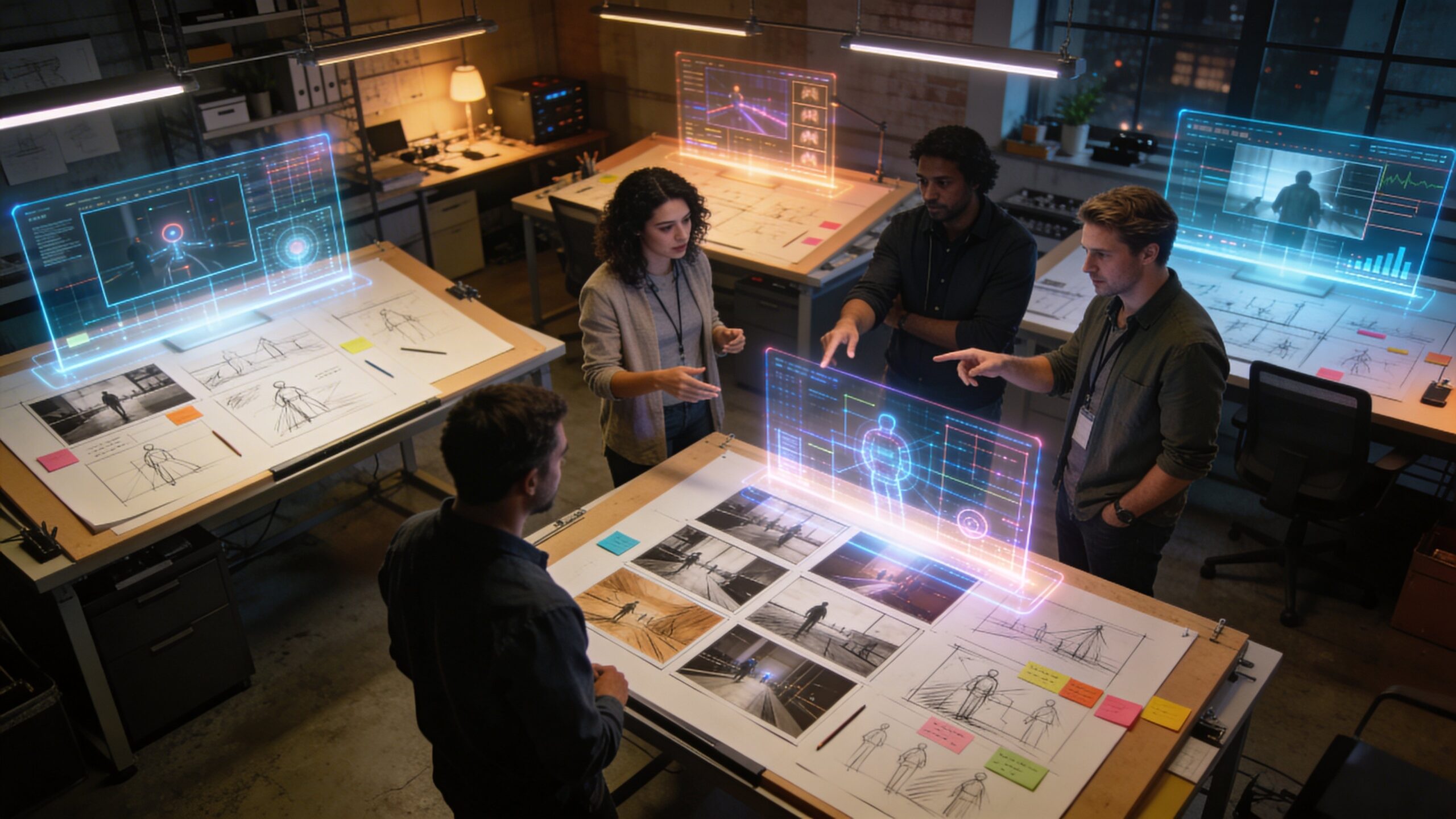
Storyboarding and previsualization have always been the bridge between imagination and execution. A script may describe emotion, movement, pacing, and scale, but translating those words into a visual plan takes time and interpretation. Storyboards help break scenes into images. Previsualization expands those images into a more dynamic sense of motion, camera placement, timing, and spatial relationship. Planning connects all of that to real-world production needs, including crew coordination, scheduling, location needs, and budget alignment. As productions become more visually ambitious, the planning phase becomes even more important. Teams need to see problems before they happen. They need to test sequences, understand coverage, and determine whether a scene works emotionally and technically. AI helps by making those early visual drafts more accessible and more flexible. Instead of waiting days for one version of a rough sequence, creators can explore multiple possibilities quickly, compare options, and refine ideas with more confidence.
How AI Supports the Storyboarding Process
Traditional storyboarding often begins with sketches, reference images, written notes, and conversations between directors, writers, and artists. That process still matters. In fact, it remains the foundation of thoughtful visual storytelling. AI simply adds another layer of speed and discovery. It can assist by converting scene descriptions into early visual references, suggesting compositions, and helping artists explore different moods, lighting conditions, angles, or environmental designs.
This can be especially useful when a creative team is still searching for the identity of a sequence. A director may know the emotional tone of a moment but not yet know the best framing. A writer may imagine a scene as intimate, tense, or chaotic, but the visual rhythm may still be unclear. AI tools can help generate rough concept directions that give the team something tangible to react to. Even when those first outputs are imperfect, they spark conversation and accelerate decision-making. Instead of beginning with a blank page, the team begins with possibilities.
Turning Written Ideas Into Visual Language
One of the biggest advantages of AI in preproduction is its ability to translate abstract ideas into visible forms. Scripts are full of meaning, but they do not automatically reveal shot design, blocking, visual emphasis, or emotional composition. AI helps bridge that gap by giving storytellers quick ways to test how written scenes might look as sequences of frames.
This is valuable not because AI always gets it right, but because it gives creators a fast visual starting point. A dramatic confrontation in a narrow hallway, a sweeping reveal of a futuristic city, or a quiet close-up at golden hour can be mocked up and examined earlier in the process. Directors can see whether a moment feels too static. Designers can identify whether a world feels too crowded or too empty. Producers can begin evaluating scale and complexity. That movement from written intent to visual approximation is where AI begins to show real production value.
Making Previsualization Faster and More Flexible
Previsualization goes beyond still images. It allows filmmakers and creative teams to explore motion, pacing, action, camera paths, and scene geography before entering production. In traditional workflows, previs can be time-intensive and often requires specialized artists and software. AI is helping shorten that timeline by generating preliminary assets, helping organize scene logic, and speeding up the creation of rough visual sequences. This makes experimentation easier. A team can test whether a chase sequence flows clearly, whether a reveal lands at the right moment, or whether an action beat reads from the intended camera angle. Instead of treating previs as something reserved only for large productions, AI is helping make visual planning more available to smaller teams as well. That opens the door for independent creators, agencies, content studios, and smaller production houses to work with a level of visual preparation once limited to bigger budgets.
Helping Directors Communicate Vision More Clearly
A director’s job often involves translating instinct into collaboration. They may know exactly how a scene should feel, but conveying that to cinematographers, production designers, VFX teams, editors, and clients can be difficult without a shared visual language. AI can help directors articulate tone, scale, and visual intention with more speed and clarity during development.
Instead of describing a sequence only in words, a director can generate early visual references, explore framing options, and present an evolving visual treatment to the team. These images and sequences are not the final artwork, but they can create alignment earlier. That matters because misalignment in the planning phase often leads to confusion later on set. When more departments can see the same vision sooner, collaboration improves. AI can make that early alignment more efficient, especially when timelines are tight and creative decisions need to happen quickly.
Supporting Storyboard Artists Rather Than Replacing Them
There is often concern that AI in creative workflows will replace the artists who have traditionally shaped preproduction. In practice, the most effective use of AI tends to support artists rather than eliminate them. Storyboard artists bring narrative instinct, cinematic understanding, emotional nuance, and sequence logic that no automated tool can fully replicate. They understand why one angle builds suspense while another weakens it. They know how to create visual continuity across a scene and how to simplify information so it reads clearly.
AI can reduce some of the friction around ideation, references, and early iteration, giving artists more room to focus on interpretation and refinement. Instead of spending unnecessary time chasing raw placeholders, artists can use AI-generated inspiration as material to reshape, correct, and elevate. That can make the workflow more efficient while preserving the human judgment that makes storyboards truly effective. In the best cases, AI becomes an assistant to craft, not a substitute for it.
Improving Collaboration Across Creative Departments
One of the hidden strengths of AI in planning is how it improves communication across departments that do not always interpret scripts the same way. Writers think in scenes and themes. Directors think in emotion and pacing. Cinematographers think in light and movement. Production designers think in space and texture. Producers think in logistics and cost. AI-generated boards, previs frames, and planning documents can serve as a common reference point between all of them.
When everyone is reacting to the same visual draft, conversations become more concrete. Questions become easier to answer. Does the set need to be larger? Does the sequence require more extras? Is the camera move realistic in the available location? Can a practical effect handle the moment, or will it need digital support? AI does not answer every question by itself, but it helps teams identify the right questions earlier. That is one of the most important advantages in preproduction.
Exploring More Ideas Without Slowing the Schedule
Creative teams often face a frustrating tradeoff in development: explore more ideas, or protect the timeline. AI helps reduce that tension. Because it can assist in rapidly generating visual directions and alternate concepts, teams can test more options without derailing the schedule. A single scene may be explored as intimate or epic, handheld or formal, warm or clinical, grounded or stylized. Those comparisons help teams make stronger decisions before committing resources.
This matters because many great ideas emerge through contrast. Sometimes the best choice becomes clear only after several weaker versions are explored. Without AI, those explorations may take too long to justify. With AI, the team can move through broader creative territory more quickly. That does not mean every idea should be used. It means more ideas can be considered, challenged, and improved. In a planning environment, that flexibility can be incredibly valuable.
AI and Shot Planning for Complex Sequences
Action scenes, VFX-heavy moments, large crowd scenes, and complicated camera moves often demand detailed planning long before shooting begins. AI can help organize and visualize these sequences by assisting with frame logic, camera concepts, blocking ideas, and environmental context. For productions dealing with elaborate movement or layered visual storytelling, that kind of support can reduce confusion before crews arrive on set. In complex sequences, even small planning gaps can create major delays. A camera path may conflict with set design. A character entrance may not read clearly from the chosen angle. A visual effect may need more empty space in the frame than originally expected. AI-assisted previs and visual breakdowns can help teams spot these issues early. That makes production more efficient and can protect both budget and creative intent.
Making Planning More Accessible for Smaller Teams
Large studios have long used extensive planning tools, but smaller creative teams have often had to rely on simplified workflows due to budget or time limitations. AI is helping change that. Independent filmmakers, startup studios, content agencies, and solo creators now have more access to visual planning assistance than ever before. They can generate concept references, draft boards, and explore sequence structure without the same level of overhead that once made these stages difficult to sustain.
This does not mean AI removes the challenges of production. It means it lowers the barrier to previsual thinking. More creators can prepare scenes visually before production begins. More teams can pitch ideas with compelling visual context. More projects can enter production with stronger alignment between concept and execution. That democratization of planning tools may become one of AI’s most significant long-term impacts on visual media.
From Creative Exploration to Smarter Production Decisions
Planning is not only about art. It is also about decision-making. Every shot, set, prop, location, and effect carries a production consequence. AI helps because it connects visual experimentation to practical discussion. When teams can preview more of a project early, they can make smarter calls about scope, scheduling, and priorities. They can decide what needs more coverage, what can be simplified, and what deserves extra resources.
That leads to more strategic productions. A team may realize a location is too limiting for the intended sequence. They may discover that a scene works better with fewer setups. They may identify opportunities to reuse environments, streamline transitions, or combine shots. These are not glamorous discoveries, but they are often the difference between a production that feels controlled and one that feels chaotic. AI supports that planning intelligence by making visual foresight easier to achieve.
The Limits of AI in Story Development
For all its advantages, AI is not a substitute for story judgment. It can generate images, organize options, and accelerate iteration, but it does not inherently understand theme, human subtlety, or emotional truth the way experienced creators do. A beautifully generated frame may still misread the tone of a scene. A polished concept may still fail to serve the narrative. That is why AI should be treated as a tool within a creative process, not as the process itself. The strongest productions will continue to rely on human interpretation. Writers, directors, artists, editors, and producers are the ones who decide what matters, what resonates, and what belongs. AI can help them get there faster, but it cannot decide what makes a story meaningful. Its real value comes from accelerating exploration, not replacing taste. That distinction is essential for teams who want to use the technology wisely.
Why Human Vision Still Leads the Way
Every memorable storyboard and every effective previs sequence ultimately comes from a point of view. It comes from someone deciding what the audience should notice, what they should feel, and when they should feel it. AI can help create options, but it is human vision that chooses the right one. That is why the best creative teams do not ask AI to invent the soul of a project. They ask it to help reveal and refine the possibilities around that soul.
In practice, this creates a powerful partnership. Human creators bring intent, emotional intelligence, and narrative strategy. AI brings speed, variation, and early visualization support. Together, they can shorten the distance between concept and communication. That does not make creativity less human. In many cases, it gives creators more time and space to focus on the decisions that matter most.
The Future of Preproduction Is More Visual and More Adaptive
As AI tools continue to improve, storyboarding, previsualization, and production planning are likely to become more interactive, iterative, and deeply integrated across the creative pipeline. Teams may move from script to visual treatment more quickly, from visual treatment to previs more smoothly, and from previs to production with fewer unknowns. Planning will become less about static handoff documents and more about living visual systems that evolve alongside the project.
That future does not diminish artistry. It strengthens preparation. It gives filmmakers and creative teams more ways to explore ideas before making costly commitments. It encourages experimentation without requiring constant reinvention of the workflow. Most importantly, it helps transform uncertainty into usable visual direction. In a field where clarity can save both money and creative momentum, that is a major advantage.
Conclusion: AI as a Creative Accelerator for Better Planning
AI is changing the way visual stories are prepared long before cameras roll. In storyboarding, it helps translate ideas into images. In previsualization, it helps teams test motion, timing, and composition. In planning, it helps creative and production departments align around a clearer shared vision. It does not replace the instincts of directors, storyboard artists, or designers. Instead, it helps them work with greater speed, flexibility, and confidence. The result is not less creativity. It is often more focused creativity. When teams can see ideas earlier, test them faster, and adjust them with less friction, they are better equipped to tell stronger stories. That is why AI is becoming such an important part of modern preproduction. It is not simply about automation. It is about giving storytellers better tools to imagine, shape, and plan what comes next.