Introduction: The Camera Has Changed, But the Craft Has Not Disappeared
Artificial intelligence has moved from a futuristic filmmaking buzzword to a real creative tool sitting inside editing suites, writing rooms, concept art workflows, previs pipelines, marketing departments, and independent creator studios. It can generate storyboards, clean audio, remove backgrounds, create synthetic environments, suggest edits, build mood boards, upscale footage, translate dialogue, and even produce short video clips from a written prompt. For filmmakers, that sounds like a revolution. In many ways, it is. But the real story is more complicated, more interesting, and far more human than the hype suggests. The real limitations of AI in filmmaking today are not just technical. They are creative, legal, ethical, emotional, logistical, and artistic. AI can accelerate parts of the process, but it does not automatically understand taste, tension, performance, authorship, continuity, subtext, or why a quiet look between two characters can matter more than an explosion. It can produce impressive images, but filmmaking is not simply image generation. It is intention, rhythm, collaboration, memory, performance, trust, and a thousand tiny choices that turn moving pictures into meaning.
A: It can help create pieces of a movie, but full professional storytelling still requires human direction, editing, legal review, and creative control.
A: It is strongest for concept art, previs, rough storyboards, cleanup, transcription, localization, and early creative exploration.
A: It struggles with long-form continuity, nuanced performance, exact directorial control, physical realism, and legal clarity.
A: It may replace some low-budget synthetic work, but believable human performance, consent, and audience trust remain major barriers.
A: AI can suggest ideas and drafts, but strong screenwriting depends on voice, structure, subtext, theme, and lived experience.
A: It depends on the tool, license, source material, likeness rights, contracts, and distribution requirements.
A: Motion, physics, hands, object permanence, faces, and fine details can shift during generation.
A: Yes, when it supports planning, speed, and experimentation without replacing core creative judgment.
A: Sometimes, but professional output still requires cleanup, iteration, supervision, and legal confidence.
A: Use AI early for ideas and efficiency, then rely on human artists for story, performance, final polish, and meaning.
AI Can Generate Images, But It Still Struggles With Story
One of the biggest misunderstandings about AI filmmaking is the belief that because AI can create cinematic-looking footage, it can also create cinema. A beautiful shot is not the same as a strong scene. A strong scene is not the same as a compelling sequence. A compelling sequence is not the same as a finished film. AI can imitate the surface language of movies—the lighting, the camera movement, the costume style, the dramatic atmosphere—but story depends on cause and effect, emotional escalation, character contradiction, and carefully controlled information.
A filmmaker does not just ask, “What looks cool?” A filmmaker asks, “What does the audience need to feel right now?” AI often struggles with that deeper narrative architecture. It may create a dramatic battlefield, a lonely diner, or a futuristic city, but it does not naturally know why the scene exists, what changed inside the character, or how this moment echoes something from twenty minutes earlier. It can assist storytelling, but it is not yet a reliable substitute for a storyteller with taste, memory, and emotional judgment.
Continuity Remains a Major Weak Point
Filmmaking depends heavily on continuity. The same character must look like the same person from scene to scene. Props must remain consistent. Locations must feel connected. Costumes must match. Lighting must obey a visual plan. A character cannot have a scar in one shot, lose it in the next, and regain it during the emotional climax unless that choice has a reason. AI-generated video still struggles with this kind of long-form consistency.
This becomes especially obvious when creators try to build a complete film rather than a short concept clip. A single AI-generated shot can look stunning, but ten connected shots may reveal shifting faces, changing wardrobe details, inconsistent architecture, unstable object placement, or altered camera logic. For social media experiments, that may be acceptable. For professional filmmaking, continuity errors break immersion and make the audience feel the machinery behind the illusion.
Performance Is More Than a Face Moving Correctly
AI can generate faces, voices, gestures, and expressions, but performance is not just the arrangement of facial muscles. Great acting carries hesitation, contradiction, silence, timing, vulnerability, and instinct. A human actor can surprise a director. They can interpret a line in a way that changes the entire scene. They can listen, react, pause, resist, or bring personal experience into a moment. AI performance often looks convincing at first glance, but it can feel hollow when emotional complexity is required.
The limitation becomes most visible in dramatic scenes. AI may create a face that appears sad, angry, or joyful, but it often struggles with layered emotion. A character might be smiling while hiding grief, speaking calmly while suppressing panic, or looking away because the truth is too painful. These are not just visual states. They are emotional strategies. Human performers understand pressure, memory, and intent in ways current AI systems can only approximate.
Directors Still Need Control, Not Just Surprise
AI tools are often impressive because they produce unexpected results. That surprise can be useful in early creative exploration. A director can use AI to discover visual moods, test styles, or generate unusual ideas. But professional filmmaking depends on control. Directors need to repeat a shot, adjust a lens choice, refine blocking, protect continuity, match a performance, and make specific choices under pressure.
The problem is that many AI systems are still prompt-driven rather than fully director-driven. You can describe what you want, but the system may deliver something adjacent instead of exact. A filmmaker might ask for a slow, restrained push-in with natural morning light and receive a glossy, dramatic camera move that looks expensive but feels wrong. In filmmaking, “almost right” can still be wrong. The more specific the creative need, the more obvious the limitations become.
AI Has a Problem With Physical Reality
Films may be illusions, but they are built on physical rules. Bodies have weight. Fabric moves in certain ways. Hands interact with objects. Smoke behaves differently from water. Reflections obey geometry. A fight scene depends on impact, distance, balance, and timing. AI video can generate convincing motion, but it can still produce subtle errors that make a scene feel uncanny.
These issues are not always obvious in a single frame. They appear in motion: a hand melts into a glass, a necklace changes shape, a character walks without natural weight, a vehicle moves without believable traction, or a background object appears and disappears. For stylized work, these flaws can sometimes be hidden. For realistic filmmaking, they can destroy the viewer’s belief in the scene.
Editing Is Still a Human Language
AI can help edit faster. It can sort footage, find highlights, create rough cuts, clean dialogue, generate captions, suggest pacing, and automate repetitive tasks. But editing is not just arrangement. Editing is emotional architecture. It decides when the audience learns, when they breathe, when they worry, when they laugh, and when they finally understand. A cut can make a character seem guilty, innocent, powerful, weak, sincere, or deceptive.
The best editors do not simply assemble footage. They listen to rhythm. They understand silence. They know when not to cut. They recognize that a reaction shot can carry more meaning than the line that came before it. AI can support the workflow, but it still struggles to understand the invisible emotional math of a scene. It may identify the cleanest take, but not always the truest one.
The Legal Landscape Is Still Unsettled
One of the most serious limitations of AI in filmmaking today is legal uncertainty. Filmmakers need to know who owns the material they create, what training data influenced the output, whether a generated image resembles copyrighted work, and whether a synthetic voice or face violates someone’s rights. These questions matter because films are commercial products. They require distribution, insurance, contracts, credits, clearances, and long-term ownership.
A short experimental clip may not face much scrutiny, but a feature film, commercial campaign, or streaming release operates in a different world. Producers need legal confidence. Studios need chain of title. Actors need consent protections. Writers need credit clarity. Directors need to know whether their generated assets can be safely used. Until the legal environment becomes more predictable, AI will remain powerful but risky in professional pipelines.
Likeness and Consent Are Central Issues
AI filmmaking raises urgent questions about identity. A performer’s face, voice, movement, and mannerisms are not just data points. They are part of a career, a livelihood, and a personal identity. The ability to create synthetic performers or imitate real people has forced the industry to confront consent in a new way. Who has the right to recreate an actor? Can a background performer be scanned and reused? Can a voice be cloned for revisions? What happens when a performer is no longer alive?
These are not abstract questions. They affect contracts, casting, labor rights, and trust between artists and studios. AI may reduce production costs, but filmmaking is not only about efficiency. It is also about people agreeing to participate in a shared creative act. Without clear consent, AI becomes less like a tool and more like a threat.
AI Can Flatten Originality
AI systems are often trained to recognize and reproduce patterns. That makes them excellent at generating familiar styles, genres, moods, and visual references. But filmmaking grows when artists break patterns. A new movement, a strange performance, an unexpected camera choice, or an unconventional story structure can reshape what audiences expect. AI tends to be strongest when asked to remix what already exists.
This can lead to a polished sameness. Many AI-generated scenes look cinematic in a generic way: moody lighting, shallow depth of field, dramatic fog, neon reflections, symmetrical compositions, and expensive-looking surfaces. The results can be beautiful but strangely anonymous. The limitation is not that AI lacks style. It is that AI can produce style without a point of view. Great filmmaking needs more than aesthetic confidence. It needs a reason to exist.
Preproduction Is Easier, But Not Effortless
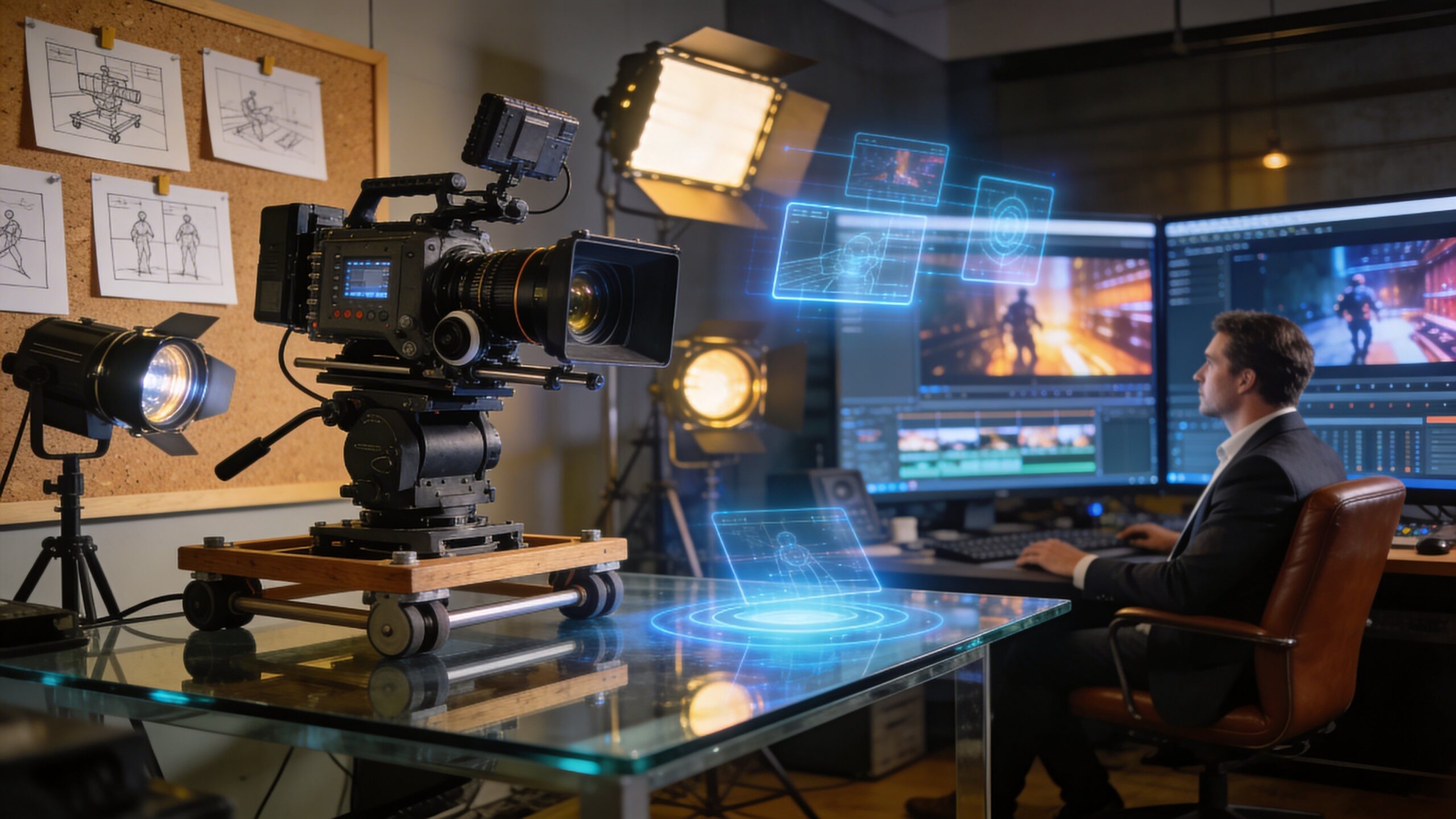
AI is extremely useful in preproduction. It can help develop visual references, generate location concepts, explore costume directions, build pitch materials, and create quick storyboards. For independent filmmakers, this is one of the most exciting areas because it lowers the barrier to visual planning. A director who once needed a large art department to communicate a vision can now create early concepts quickly.
Still, AI preproduction has limits. A mood image does not solve scheduling. A generated set design does not confirm construction cost. A fantasy location does not answer whether permits are available. A storyboard does not guarantee that a shot can be captured with the available crew, lens package, lighting, weather, time, and budget. AI can make the dream clearer, but producers still have to make the dream practical.
AI Cannot Replace On-Set Problem Solving
A film set is controlled chaos. Weather changes. Actors discover better choices. Locations fall through. Equipment fails. A scene that worked on paper feels false in rehearsal. A director has to adjust, communicate, prioritize, and protect the heart of the project in real time. AI does not replace that kind of leadership.
On-set filmmaking requires human judgment because every decision affects morale, money, safety, performance, and the final image. A director may choose to abandon a planned camera move because an actor’s stillness is more powerful. A cinematographer may reshape lighting because the location has an unexpected texture. A production designer may solve a problem with a piece of tape and a brilliant instinct. AI can help prepare, but it cannot fully replace the living intelligence of a crew responding together.
The Budget Promise Is Often Oversold
AI is frequently marketed as a way to make films cheaper. Sometimes it does. It can reduce costs in concepting, cleanup, transcription, localization, previs, and certain visual effects tasks. But the idea that AI automatically makes professional filmmaking inexpensive is misleading. High-quality AI workflows still require skilled artists, powerful hardware, subscriptions, iteration time, legal review, post-production cleanup, and creative supervision.
In some cases, AI shifts costs rather than removes them. Instead of paying for one kind of labor, productions may pay for prompt development, asset management, cleanup, compositing, rights review, and quality control. Cheap output is easy. Usable output is harder. Finished, professional, legally safe, emotionally effective output is harder still.
Audience Trust Is Becoming Part of the Craft
Modern audiences are increasingly aware of synthetic media. Some viewers are excited by it, while others are skeptical. When AI is used carelessly, audiences may feel tricked, especially if a film blurs the line between real performance and generated material without transparency. This matters because trust is part of the viewing experience.
Not every use of AI needs to be announced loudly, just as not every visual effect needs a disclaimer. But filmmakers must think carefully about authenticity. Is AI being used to support the story, or to fake something meaningful? Is it helping artists, or replacing them without consent? Is it expanding imagination, or eroding confidence in what the audience sees and hears? These questions will become more important as synthetic media becomes harder to detect.
AI Works Best as a Collaborator, Not a Replacement
The strongest use of AI in filmmaking today is not replacing the filmmaker. It is extending the filmmaker. AI can help a small team move faster. It can make early ideas visible. It can remove repetitive technical barriers. It can give independent creators access to tools that once belonged only to larger studios. Used well, it can support imagination rather than flatten it.
The key is creative authority. The filmmaker must remain the decision-maker. AI should not decide the emotional truth of a scene, the moral center of a story, or the identity of a performer. It should be guided, challenged, corrected, and shaped. Like a camera, a lens, or an editing system, AI becomes valuable when it serves a vision. It becomes dangerous when the tool becomes the author by default.
The Future Is Powerful, But Not Automatic
AI in filmmaking will continue to improve. Video consistency will get better. Character control will improve. Editing assistants will become smarter. Virtual production will become more accessible. Synthetic dubbing, cleanup, and localization will likely become standard parts of many workflows. The future will not be a simple battle between humans and machines. It will be a negotiation over authorship, ethics, economics, taste, and control.
The filmmakers who thrive will not be the ones who ignore AI or worship it. They will be the ones who understand its strengths and limitations clearly. They will use AI where it adds speed, scale, and possibility, while protecting the human elements that make cinema matter: performance, authorship, collaboration, emotion, risk, and point of view.
Conclusion: AI Can Make Footage, But Filmmakers Make Meaning
The real limitations of AI in filmmaking today reveal something important about the art form itself. Movies are not powerful because they contain moving images. They are powerful because they organize images, sound, performance, silence, and time into an experience that feels alive. AI can generate pieces of that experience, sometimes beautifully. But it still struggles with the deeper work of meaning.
For filmmakers, the opportunity is enormous, but so is the responsibility. AI can be a sketchbook, a production assistant, a visual effects accelerator, a brainstorming partner, and a technical problem-solver. But it is not a replacement for taste, consent, performance, story, or human judgment. The future of AI filmmaking will not be defined by whether machines can make movies. It will be defined by whether artists can use machines without losing the soul of the work.